Pastiche and How Great Filmmakers Steal…PERIOD!

A wise man once described Film as the newest form of art of the 20th century which can also be defined as a series of images projected on a screen. And the succession of images creates ideas which, in turn, generate emotions.

Pastiche, which is a term used in the literary and film world, can be termed as TV’s gift to contemporary philosophy and film. It can be defined as an artistic work in a style that copies that of another artist, work, or period. Pastiche in the context of Film is described as a cinematic device that honors the cinematography of another filmmaker through the imitation of specific scenes or iconic moments in the movie. Sometimes, it could be a reboot of the entire movie or just some scenes.

Check out this amazing video by CrackerJacked


Support CrackerJacked’s Pateron.

Another term used to define Pastiche is MISE EN SCENE (Placing on Stage). ‘Mise En Scene’ describes the composition, prop placement and overall visual theme adopted during the filming process. It’s important not to confuse this term for Parody; which is intended for its comedic value.

The shows, Stranger Things and Mr. Robot have one thing in common (apart from employing actors that have been nominated for Golden Globes), which is the use of Pastiche during its production.

Stranger Things is a typical case of Pastiche of almost every iconic sci-fi film in the 80s. An excellent example of this is seen at the end of the first episode when the boys discover El in the woods. This scene imitates the one in E.T where Elliot finds E.T in the cornfield.

“Good artists copy, Great artists steal.”

The Duffer Brothers who wrote Stranger Things admitted to recreating most of the iconic scenes in the series as a tribute to their favorite movies growing up; most of which were from the 80s. They managed to capture the supernatural and terrifying worlds created by big names like Wes Craven and Ridley Scott; while also managing to slap adult viewers in the face with nostalgia.

Similarly, Mr. Robot is a Pastiche for several iconic action films like; David Fincher’s ‘Fight Club,’ and the Matrix. The series protagonist has an imaginary friend (his late father) and provides voice-over narrative throughout the series, which is similar to Edward Norton’s character in Fight Club. Also, the storyline of Mr. Robot revolves around a Hacktivist group called F society, which is not so different from Project Mayhem in Fight Club. The only glaring difference between the two was that while Mr. Robot wrecked Virtual Havoc on the world, Project Mayhem acted out physical acts of destruction.

There was also a scene where Elliot had a conversation with his dead father (imaginary friend), which was gotten from The Matrix, word for word.

Being able to emulate key elements from great works of art is what makes Pastiche a gift to film and contemporary philosophy. Imitating elements of specific films not only honors the cinematography of the original work, but it also provides new context and further explores the themes present in the originals. Evoking nostalgia in film buffs and super fans is also a bonus. To quote the words of another wise man;


Film Meet Art: How Famous Paintings Inspire Great Filmmakers

We all know that many filmmakers have been inspired by famous paintings. Directors like Quentin Tarantino, Sofia Coppola, Steven Spielberg, Stanley KubrickPaul Thomas AndersonMartin Scorsese and Terry Gilliam have pulled directly from the art world to create some of their masterpieces.

A remarkable video essayist Vugar Efendi, has created a stunning series of video essay call “Film Meets Art”. In these videos, Vugar explores film shots and the famous painting that inspired them. Filmmakers should find inspiration from all art forms, not just by watching films.

The art world has an endless supply of inspiration for today’s generation of filmmakers. Check out this very cool series of videos below.

Spoiler

I do believe that film being the newest art of the 20th century, is a series of images projected on a screen. And this succession of images create ideas which in their turn, create emotion. Just as much as in literature.

Words put together creates and Stranger Things and Mr. Robot both have one thing in common. That is one thing in addition to featuring actors who are nominated for Golden Globes, they both employed a cinematic device called pastiche. pastiche in the context of film is a cinematic device that honors and other filmmakers cinematography through an imitation or reboot of specific iconic moments or the meson sin, which is a term used to describe composition, prop placement, and overall visual theme. It’s important not to confuse this with parody, which marks an artist’s work for comedic value.

To start, let’s look at Stranger Things. Stranger Things is a pastiche of basically every iconic at sci fi film. A great example of pastiche early on in the series is the end of the first episode when the boys discover l in the woods. This is normal, identical recreation of this unity t where Elliot stumbles upon et in a cornfield. This is just one of many references to popular 80s movies. The duffer brothers, who wrote Stranger Things openly admitted to recreating iconic scenes in Stranger Things as a tribute to their favorite movies growing up.

They managed to capture the supernatural and terrifying worlds created by big names like Wes Craven, and Ridley Scott, and also the essence of 80s children’s adventure films with classic groups of misfits getting into trouble recreating elements of Richard Donner’s Goonies and Rob Reiner stand by me, these few examples don’t even cover half of the unmistakable references. Overall, the duffer brothers did an incredible job of slapping adult viewers in the face with nostalgia.

Mr. Robot in many ways is a pastiche of various iconic action films. You can see within the first few episodes a striking thematic pastiche of David Fincher is fightclub. Throughout the series, Elliott provides voiceover narrative classes I can manage all easier than the others, for now anyway. And during certain seasons, he even talks to an imaginary person, which is identical to Edward Norton’s character and fightclub comment from the road if there’s any snags, he needs to look that must have had his grand a latte enema. Also, Mr. Robot storyline revolves around a hacktivist group called f society, which is not too far from Project Mayhem and Fight Club.

The only real difference is that Mr. Robot wreaked virtual havoc on the world. While project may have acted out physical acts of destruction, there’s also a scene where Elliot and his imaginary dead father carry out a conversation that’s word for word from the matrix, which creator Sam Esmail openly and somewhat proudly admitted to, let me tell you why.
You’re here because you said something wrong with the world. Something you can’t explain. But no, it controls you and everyone you care about. Do you want to know what it is? Money.

So what does all of this have to do with contemporary philosophy? Well, everything. Many recognized philosophers working within the tradition of continental philosophy, advocate film and its contribution to philosophy.

So let’s look at Mr. Robot and its pasties your Fight Club. Mr. Robot is as much about hacking as Fight Club is about fighting and terrorism. What I mean by that is they’re more about what makes a person who they are than what they do.

I’m only a vigilante hacker by night by day just a regular cyber security engineer. The creators of Fight Club did an incredible job at exaggerating the existential crisis that many people experience in corporate America. A man builds his life around a perpetual cycle of working and spending and is constantly craving anything that makes him feel something eventually makes the decision to try and change the corporate system that left him feeling so empty. The creators of Mr. Robot re explored that theme through their lead character Eliot providing a more modern context. What is it about society that disappoints you so much?
I don’t know.

And this is exactly why pastiche is a gift to film and contemporary philosophy. imitating elements of specific films not only honors the cinematography and genius of the original, but it provides new context and further explorations of themes present in the originals. It also evokes an incredible amount of nostalgia for film buffs and super fans.

In many ways, creators of cinematic television like Sam as Mel and the duffer brothers have demonstrated a groundbreaking approach to TV and even film. Whether there truly is a chance for new film and cinematography to emerge that is unique to everything else before it. They tease the question why not just stick to what you love?

YouTube Audio Library – Get Royalty-Free Tracks for Your Films

“Royalty-Free” doesn’t mean it’s free music for you to download and do with it as you please. It just means you don’t pay any royalty fees. Let me explain, once you purchase the track of music, you can use it in a Vimeo or YouTube video, usually once, and you don’t have to pay anything else regardless on how many times the video is seen, 10 times or 1,000,000 times, it doesn’t matter. You pay a one-time flat fee and you are good.

Today you have so many choices for free royalty-free music. The YouTube Audio Library has thousands of songs (provided as 320 Kbps MP3 files) you can use in your videos, films, shorts, and productions at no charge.

These tracks can also be used in commercial video productions, films, and shorts. For some more details on that click here:

  • Attributing your video: If you see an attribution-required icon next to a track, make sure to credit the original artist in your video description. Learn more about attribution on the Creative Commons website.
  • Monetizing your video: You can monetize your video since free music isn’t claimed through Content ID. If you’re prompted to show that you have commercial use rights to the music, just make sure to include the music’s exact title and that you downloaded it from the YouTube Audio Library. Learn more about supplying documentation to claim rights.

To gain access to the YouTube Audio Library, head on over to the YouTube Audio Library.

SHORTCODE - SOUND FX

Need Sound Effects for your short or feature film project?

Download 2000+ sound effects designed for indie filmmakers & their projects for free.

Here are some other amazing resources for royalty-free music:

Free Music Archive

The Free Music Archive is an interactive library of high-quality, legal audio downloads directed by WFMU, the most renowned freeform radio station in America. Radio has always offered the public free access to new music. The Free Music Archive is a continuation of that purpose, designed for the age of the internet. It was launched in 2009.

Every MP3 you discover on The Free Music Archive is pre-cleared for certain types of uses that would otherwise be prohibited by copyright laws that were not designed for the digital era. These uses vary and are determined by the rights-holders themselves (please see our FAQ) who feel that allowing a degree of free cultural access is beneficial not only to their own pursuits but to our society as a whole. The Free Music Archive is a resource for audiophiles of all stripes, and unlike other websites, all of the audio has been hand-picked by one of our established audio curators.

http://freemusicarchive.org


Moby Gratis

This site is a resource for independent and non-profit filmmakers, film students, and anyone in need of free music for their independent, non-profit film, video, or short.

Moby has made a selection of over 150 tracks from his huge catalog of music available to license for free, via a simple online application system.

http://www.mobygratis.com

IFH 471: The Complete Guide to NFT in Independent Film (and How to Make Money)


Right-click here to download the MP3

So today we are going to go down the rabbit hole of NFTs. What the heck is an NFT? It is a Non-Fungible Token. Basically, an NFT is a completely original digital file or a digital collectible which is registered on a blockchain ledger just like any cryptocurrency.

But unlike cryptocurrency, like Bitcoin or Ethereum, an NFT is totally unique and because it lives on the blockchain it verifies who is the rightful owner of this one-of-a-kind digital collectible file.

In February 2021, digital artist Peebles sold a digital artwork for $69.3 million at auction. You heard correctly almost $70 million for a digital file. The founder of Twitter, Jack Dorsey, sold his very first tweet as an NFT for $2.9 million.

It took me a minute to understand what these things were and then it clicked. In short, they are digital collectibles. NFTs essentially are digital baseball cards, comic books, Garbage Pail Kids, Funkos, or Pokemon cards. They are just a digital version and in many ways better because you know exactly how many copies exist.

I’ve already had conversations with Hollywood executives that told me that the studios are coming very soon and they are coming hard. Hollywood is beginning to see the value of NFTs and when they come in it will be a feeding frenzy. Imagine Marvel Studios, Harry Potter, Star Wars, or Pixar NFTs. It’s going to be insane.

Could Oscar® winning screenwriters create NFTs for their screenplays? Could a popular filmmaker create NFT short films? Would you buy an NFT from Chris Nolan, David Fincher, Aaron Sorkin, or Quentin Tarantino?

The NBA is selling “moments” as NFTs through NBA Top Shots. Basically, they are selling highlight clips as NFT and are killing it. Fans of the NBA are gobbling these NFTs as fast as they are released. I really think there is now one doing NFTs better than the NBA right now.

Musicians are having amazing success selling NFTs directly to their fans. This is turning the established music industry on its head. NFTs are essentially killing off the middle man. No more label, just a direct relationship with the artist’s fans.

The other amazing thing about NFTs is that the artist continues to make money on every sale of the NFT forever. Let me explain. When an artist creates an NFT by “minting” it. Minting is the process of create the digital file (NFT) and placing it on the blockchain. The artist then sets the residual percentage every time the NFT sells.

So if I mint a short film and sell it for $500. I get $500. Now, if the new owner sells it 2 years from now for $10,000 I get 10% of that sale. Every time that NFT is resold I get my cut. All transactions are transparent. All on the blockchain.

So how can filmmakers make money? There are so many options because NFTs are in their infancy. Everyone is trying to figure out how to use them in indie films.

Indie Film legend Kevin Smith is selling the distribution rights to his new horror anthology Killjoy. He has even created his own NFT Studio called JAY & SILENT BOB’S CRYPTO STUDIO PRESENT SMOKIN’ TOKEN NFTS. Here’s some info on Kevin’s new endeavor.

Since their first appearance in CLERKS over twenty-five years ago, Jay and Silent Bob have been selling out to the world of collectibles! From t-shirts to toys, the stoner duo’s likenesses have been stuck on both tacky and tremendous trinkets treasured around the globe!

Now Jay and Silent Bob blaze into blockchain with crypto-collectibles called Smokin’ Tokens!

From Jay & Silent, Bob’s Crypto Studio comes the first in a series of NFT’s that celebrate the many movies of New Jersey’s least likely heroes. The inaugural Smokin’ Tokens commemorate the pair’s latest cinematic adventure,

JAY AND SILENT BOB REBOOT – featuring amazing art by fan-favorite  John “Captain RibMan” Sprengelmeyer!

You gotta love Kevin Smith. He’s always looking for new ways to connect with his fans. His first collection of NFTs almost completely sold out. There might be something here boys and girls.

Some other ideas are:

  • Selling the distribution rights to your film in shares like the indie film Lotawana
  • Create  an NFT for a short film to finance it
  • Sell NFT collectibles from the film
  • Fundraise your budget with NFTs
  • Anyone with a fanbase or that can tap into a fanbase can and should create NFTs
  • Social Media Influencers, YouTubers, any company with IP that has fans should be all over NFTs.

These are just some ideas. I decide to throw my hat in the ring and created an experiment. I minted a few NFTs for my first short film BROKEN and some “legacy NFTs” of the first-ever filmmaking tutorials ever uploaded to YouTube. Here is the description of one of the NFTs.

SHORTCODE - SOUND FX

Need Sound Effects for your short or feature film project?

Download 2000+ sound effects designed for indie filmmakers & their projects for free.

I decide to throw my hat in the ring and created an experiment. The Indie Film Hustle NFT Collection. I minted a few NFTs for my first short film BROKEN and some “legacy NFTs” of the first-ever filmmaking tutorials ever uploaded to YouTube. Here is the description of one of the NFTs.

This NFT is called Muzzle Flash Breakdown and is one of the first filmmaking tutorials to ever be uploaded to YouTube. It was uploaded on August 28, 2006, by filmmaker, author, and Indie Film Hustle Podcast host Alex Ferrari from his 2005 award-winning short film BROKEN. 

It was taken from the best-selling DVD of the film. That DVD was one of the first indie short films to ever create a massive collection of tutorials and making of videos that explained how to make a low-budget independent film with off-the-shelf software and digital consumer cameras.  

This is part of a limited series of filmmaking tutorials that were uploaded to YouTube from the short film BROKEN. All the videos were uploaded and released on the same day in 2006. The external link attached to this NFT will show the original upload to YouTube.

Link: https://www.youtube.com/watch?v=yFPoBZY5BrA

When you purchase this NFT you will also gain access to the short film BROKEN, the entire collection of tutorials and commentary tracks via private link and passcode. You will also receive the original QuickTime file that was uploaded to YouTube.

To access my NFTs go to: www.ifhnft.com

I released three of 6 of the total filmmaking tutorials I uploaded on YouTune back in Aug 2006. If these sell out I’ll upload the rest and maybe some of my other popular short films I directed over the years. I wanted to give you an example of what an independent film NFT looked like and this is totally an experiment to see what happens.

Maybe I’ll never sell an NFT, maybe I sell them three years from now or maybe they will sell out in 15 min. Who knows. What I am excited about is the potential of what this could mean for the indie filmmaking community.

UPDATE: In less than 72 hours I sold out of my first ever NFTs. I just added the second part to the film tutorial series as well as the FIRST Indie Film Hustle Podcast Episode NFT. Click here to check it out.

In this episode, I break down everything you need to know about NFTs, how to make money with them, and more. Enjoy!

Alex Ferrari 0:02
Now, there's been a lot of talk lately about this thing called NFT's. And it's going to revolutionize the world of the artist and being able to put the money back into artists pockets. And of course, when I heard about this, I was like, Well, what does this mean for us as independent filmmakers. So I wanted to put together an episode that would be a guide to all independent filmmakers out there on what NFT's are, and the many different ways you can use them to possibly generate revenue for your film or fundraise for your film or distribute your film and so many other things and we'll talk about that in this episode. But let's first off talk about what an NFT is. An NFT is a non fungible token, which means that is a unique digital file that is registered on the blockchain. Now before I continue with NFT, I need to explain to you what blockchain is. Now, many of you might have heard the term blockchain associated with cryptocurrency like Bitcoin, or aetherium, or Dogecoin, or some many other cryptocurrencies out there.

The technology of blockchain is revolutionary, and I personally believe it will transform the world, if not as big or bigger than the internet did. I know that's a very big statement. But you'll understand in a minute, what blockchain is basically, is a ledger. It is a public ledger, that cannot be messed with hacked, adjusted, and it's completely transparent for everybody to see. So every time there's a transaction, it gets put on a blockchain, and then that blockchain is registered there. And then the next page in that ledger, let's say, which we call a block will be the next one. And then other transactions happen there, and then another one and another one, and it goes on for infinity.

But you can't go back to page two or three and adjust something or erase a number or change something, because it will screw up the entire blockchain. And it's on it's impossible to do. So Bitcoin has been around for 13 years since 2008, when it was first released. And I was the first time the concept of blockchain was presented to the world. In that time, no one has been able to hack, modify or adjust the Bitcoin blockchain. It is not possible to do it is as perfect of an idea as anything that's come out of humanity in such a long time. And I don't want to go into so deep into blockchain but that is the basis of what NFT's are because NFT's live on a blockchain. Now when I first heard about NFT's, I was just like what I don't I don't understand what it is, is a digital file. Why are people spending millions of dollars for these digital files?

Well, in February 2021, there was a digital artist named Peebles who sold a digital artwork for $69.3 million in an auction. And the founder jack Dorsey of Twitter, sold his first tweet for $2.9 million dollars. And it is essentially a digital collectible. Now, I know a lot of you out there who are probably either my vintage or older or might not get this and I'm going to break it down for that part of the audience right now, because the younger crowd might understand what this is. It is essentially a baseball card. It is a comic book. It is a garbage pail kid. It is a a Pokemon card. They're just collectibles. But unlike those examples I gave you where there is hundreds if not 1000s of rookie cards out there for a baseball player.

There's only one that you could make multiple versions of it, you could do a limited run of you know, 1000 or 100 or 50 if you like, but they are digital collectibles. So in a lot of people are asking Well, why would you pay money for something that you could just download a JPEG off online for? Or buy a printer by buy a copy of it and put it up on your wall? Was there same reason why people buy cop posters and prints in limited edition prints of artist or they buy replicas of Van Gogh paintings, and put it on their walls? Because limited edition prints are the same thing as NFT's you can or if it's not limited edition prints, you want the actual print? So what would you rather own? Would you rather own the Mona Lisa?

Or would you rather own a poster of the Mona Lisa? And that's what this all is. These are that's what an NFT is it is a digital collectible. Now how is this going to work for us as independent filmmakers and screenwriters? How is that going to work? Well, let me give you an example. Let's say that Van Gogh painted a painting. And he went and sold it to a art gallery for $500. Because no one knew who Vincent van Gogh was, at the moment, he sold that painting to a gallery, someone at the gallery said this guy has some talent, let me buy this thing for 500 bucks, then fast forward five years, and Van Gogh is the biggest artist in the world, let's say. And that $500 print of that $500 painting that they bought, they go off and sell it for $30 million at auction.

Well, that's great for the the owner of the original painting. But that does nothing for the artist, the artist does not get to reap any of those rewards. And that has been the problem with art for the longest time in the art world because the artist never gets to, you know, you know, wet his beak, as they say or wet her beak, as they say, when it comes to upsells, or future revenue generated from their art. Well, the thing with NFT's is is as the artists you control what you do with your art. So if I'm an artist, I'll put my let's say digital painting up as an NFT.

And there's only one of them, and I'll auction it off, or I'll sell it at a fixed price and someone buys it for that. So let's say I put a poster up of one of my movies, and somebody out there decides to spend $1,000 for it. And I'm like great, you now own that NFT I don't own it anymore. You own it. Now let's say in a couple years, my art starts selling crazy people will really pop really want my poster art and all that kind of stuff. Well then say the original owner of that first NFT that they that was bought for $1,000 they put it back on the market and they sell it for $100,000.

Well, because I created that NFT I could put whatever percentage it is I want but because it's on the blockchain every single time that NFT is sold 10% comes back to me. That's the standard rate for this. So you could do 20% you could do 5% but standard percentages are 10%. So from here until eternity, every single time that NFT is sold somewhere else. Anywhere, anytime. instantly. I get 10% of whatever sells. So if this, this art continues to grow in value, so someone bought it for 100,000. A year later, they sell it for a million, I get 10%. In two years later, they sell it for 10 million, I get 10%, and so on, and so on and so on. So that way the artists still is able to generate revenue from their art for their lifetime.

This is revolutionary for artists in this world. Now, how does this translate to independent filmmakers? Well, when I got when I finally understood that this was basically a baseball card, a digital collectible version of a baseball card or a comic book, I'll use this analogy. Imagine that Steven Spielberg created an NFT for his shirt first short film called amblin. And that was his first short film, and he put it out as an NFT and he sold it for $100. That would be the equivalent of a Mickey Mantle rookie card. How much would ambulance shortfilm be worth as an NF? T. Today?

How much would it have been worth when jaws hit on Raiders of the Lost Ark hit or when he hit? Or when jurassic park or Schindler's List hit and all these other milestones in Steven Spielberg's career, what would that short film be worth? Would it be worth $5? Or would you be worth hundreds of 1000s of dollars? Possibly millions? That is what we're talking about here, guys. So imagine a world where filmmakers are treated like baseball players, or like your favorite comic book character, the first appearance of spider man is worth millions of dollars. But as the career goes on, let's say we keep that example going. Or I'll switch over to a contemporary director as well. Let's talk about Chris Nolan.

So Chris Nolan make he made his first feature film called the following. If we if we would have had an NFT for the following, how much would that NF t be worth today? So after that, he creates an NFT for momento. How much would that NFT be worth today. And he continues to create NFT's per movie per project that he makes throughout his career for people to buy, trade and sell, because they are now buying into him as an artist. Just like you would buy a rookie card for Mickey Mantle, but then you would also buy every year that he's playing baseball, you would buy that year's card, the equivalent would be with filmmakers. Imagine if you owned Reservoir Dogs NFT. Quinn, Tarantino's first feature film or Pulp Fiction or Django Unchained are in glorious bastard. Imagine if you had the rights, or excuse me if you owned that NFT and that could be one NFT.

Or it could be a limited edition of maybe 100 nF T's or 1000 NFT's but that's all the NFT's that will ever be made of that piece of art. Now, that's that's the way I've been able to wrap my head around this seeing like, Where can we go with this? Where can independent filmmakers go now, that is one way you can use NFT's Kevin Smith is now currently using an NFT to sell all distribution rights to his next film. Now, that means that the person who buys that NFT owns the movie owns it and can exploit it and do whatever they want with it from here until eternity.

Now, if they ever sell these rights, Kevin gets 10%. And the producers of the film gets 10%. That's one way of going about it. And also with buying the rights Kevin included in that NFT full marketing, promotions, interviews, they're gonna help the film whoever buys those rights to get it out into the world. And he has a stipulation as well that you have to release it, you can't just sit on it and just go Haha, no one will ever see this movie.

So that is another way. We have a up and coming interview with the first feature film ever independent film to ever sell NFT's for an independent film. And that film is called Lata Juana with Trevor, the director is going to be on as well as his producing partner, we're going to talk all about how he did it. And what they did, essentially was sell shares in their movie.

So you're selling shares as NFT so now every time there's money to be made from anytime there's money that comes in these, these people who own the NFT's will get a piece of the movie. So there's that's another way to make money is with NFT's and independent films. Even Another way is to essentially crowdfund your film with NFT's meaning that you can put 1000 shares for me or for your film as NFT's, and people could start buying them.

And you can set whatever price you want. You can auction it if you like. And you can raise capital to make your movie, if you have an audience if you have people who will believe in the project you're doing and so on. But this is unlike crowdfunding. It's they're just buying shares in your movie, and they can do that. Now, how is this all done? This is all done using cryptocurrency. So the reason why NFT's work it's not because they're sending you a check every single time a sale comes in, it all happens automatically on the blockchain, to your to your cryptocurrency wallet, usually it's using etherium, which is a whole other conversation.

But that is the that is the cryptocurrency that they're using for NFT's right now. But the thing is, guys, the NF T's right now are in their infancy, everyone's just trying to figure out what to do with it, what what's going on with it, how to do it, some people are selling NFT's with physical things with it, they're selling experiences with their NF t. So if you buy my NFT, you also get a hardcopy version of it. And you'll also get, you know, a conference call with me and you can maybe get an autographed picture from the store and they just constantly are packaging things together. So nobody really knows what to do with the film and how to with the with the NFT's and how to actually market it because it's all brand new.

This is essentially the internet in 1996. Okay, that's what NFT's and blockchains are right now the concept of a blockchain, people are starting to figure out imagine in 1995, if I told you to go go to this URL, nobody would have understood a lot of people would have not understood what you're talking about. There was a group of people that did, but many people wouldn't. It's the same thing. Now people are like, what is cryptocurrency? I don't know, what is a blockchain? What does that what is an NFT?

These are things that will be part of our societal vernacular, in the coming years. These things everybody will understand what an NFT is just like everybody now knows what www dot blah, blah, blah, calm means, or what at? the at symbol is for email or what email even was trying to explain what email was to somebody who didn't understand it? It's the same thing that's going on right now with NFT's blockchain and cryptocurrency and I promise you one thing the moment the studio's understand what's going on with NFT's they are going to jump in because what would you think the NFT for the latest Star Wars movie is?

Or the limited edition stuff that they're going to put out for the next Star Wars movie? Or for the next Marvel movie? What would the Avengers end game be worth as an NFT? What would Iron Man's NFT be worth and all sorts of different products and NFT's that they can create limited editions for all of these digital assets that they can create an auction off? to not only sell, make money with the actual NFT. But the marketing? Can you imagine that Disney puts up the Avengers end game NFT. And there's only one and you get to auction it, I promise you that will go from millions of dollars. And the press that they will get from that in addition to just the the money that they're going to get is going to be invaluable.

So the moment that the studio's figure this out there it's going to be they're going to just get everyone's going to go into it. Because then they're going to go into the Casa Blanca NFT, The Three Stooges, NFT's, the the jaws, NFT's and they're going to go into their archives, I'm going to pull up all of the greatest movies that they have in their catalogue and start creating NFT's from those films, because movie fans are going to want to own a digital collectible from their favorite movies. I'm telling you, this is going to happen. Can you imagine the Criterion Collection NFT of Seven Samurai? Can you imagine the Criterion Collection version of Rashomon or of any of their Chasing Amy or whatever movies that they have the NFT rights to? You mean to tell me that no Criterion Collection, collector out there will not buy the NF T of their favorite films. I'm telling you, this is going to be something it might be nothing, but I truly truly doubt it. Now I know a lot of you are asking where do I set these up? Where can I actually sell these things? Where can I create an NFT? How do you how do you create an fd?

Well, there's popular marketplaces like open sea, rare herbal and mental mental is the one that has in vestment from Mark Cuban Ashton Kutcher and a couple of other big shots. And at NBA top shots, sells pro basketball moments, like highlights, like you own the highlight from LeBron doing this, or Michael Jordan doing that. Major League Baseball is starting to finally get into it as well. And they're creating NFT's for different moments and things like that. And they're selling out like their people are going crazy for this stuff. And I know a few of you asking, Is this a fad?

Is this a bubble is it's just a waste? I personally don't believe so. I think that it is here to stay. It's going to change. But I think not only do I think blockchain is here to stay, blockchain will be here, and will be part of every fabric of our existence, in my opinion, on the digital world. In the next coming years, there's things that are being worked out things, they're trying to figure out technology wise, and in bandwidth things, the exact same stuff that people were talking about when the internet showed up.

And if you old enough to know what it was like to dial up internet through the free AOL disk, that you would get an A magazine and a computer magazine to get access to the internet, how slow it was. And nobody really understood what a website was how to build it properly. jpg wasn't even a thing then. So pictures took forever to download, all those things needed to be figured out. And that is what's happening right now with blockchain. And if t is just another thing that you could put on the blockchain, there's so many things that can be put on the blockchain.

But NFT is that so I personally don't believe that NF T's are fad, I think it's here to stay. I think it will change and maneuver and, and and morph into something else in the coming months and years moving forward. But I think it's here to stay. And it's a very exciting time, because it's something new, and it gives power back to the creator to the artists. And I mean, right now, the music industry, musicians and artists are putting out albums and NFT. And they have complete control of the money flow. And labels now are putting in their contracts that they own NFT rights as well. I promise you distribution contracts are going to start coming up that we want NFT rights. This is a thing, it's here to stay in my opinion.

So if you want to see an example of it, I decided to put a test study together. And I launched my own NFT's. Now I have the distinction unless somebody else tells me different. And I've done research and I can't find any others. I was the first person to ever upload a filmmaking tutorial on YouTube. I cannot find one any where else. I was the first one it was released August 28 2006. Now, there are six total videos I uploaded to YouTube. And I actually put in the NFT. A link to the YouTube video for proof and a provenance, if you will, of one this file was actually uploaded.

So when you buy this NFT, you will have access and you will own one of the original six uploaded filmmaking tutorials on YouTube. I only uploaded three of them currently I wanted to see what happened. And there's three other ones if you check out the YouTube page, you'll see that there's three other ones as well. I also think I have the first movie trailer ever uploaded to YouTube due because I can't find it. I beat Sony Pictures by like, a couple months of when they before they opened up their YouTube channel so I don't think I'm the only I'm the first movie trailer ever but I think I'm one of the first for sure. But right now I can't find any other any other movie trailers because now I actually uploaded those much earlier.

I forgot what date I did, but that's not an NF t But anyway, that's regardless. So that's what we call a legacy. Nf t. a legacy NF T is essentially the first ever of its kind. So the first filmmaking tutorial NFT that would be mine. A lot of wanna would be the first independent feature film ever sold as an NF t in the history of of NFTs. So those are what they call legacy NFT's so like the first tweet ever sold as an NFT is a legacy NFT. The first comic book The first baseball card, the first Garbage Pail kid, these are first Pokemon card, these aren't legacy, NFT. So those are things that you should look out for as well. So I put these three up, made it really affordable right now currently because aetherium has gone down in price is 65 bucks. If Ethereum, the cryptocurrency goes back up, when I put first posted them, it was like 125 bucks. So it went down a bunch. So now they're 65 bucks, 64 bucks.

So it will range depending on when you buy it. Now, obviously 65 bucks is not going to make or break me, I'm using this as an experiment, I want to see what happens. I want to see if there's anybody out there in the indie film hustle tribe that finds value in that. And you're not only buying that NFT because of its legacy, but you're also buying it because I put it up. And hopefully one day, I will do other things in my career where these will become much, much more valuable. I have no idea. We'll see. But it's just a really interesting experiment. And another NFT I put up was to my first short film broken, which many of you know and listen to my podcast? No, it was in over 200 film festivals, it was reviewed by Roger Ebert.

It was basically the start of me even thinking about doing something like indie film hustle back then where I created a DVD that sold 5000 copies made over 100,000 bucks as a whole. All sorts of stuff, I'll put links to all the story if you haven't heard that story in the in the show notes, but I put it up as an NFT. To see what you know, if you believe that one day, I will do something artistically that will become more valuable. or for whatever reason, I become more popular. And this becomes more valuable. It might be a good investment. I don't know, this is a weird conversation, because I'm the artist saying hey, maybe one day I'll be big guys. And this will be worth a lot of money. I have no idea. This is an experiment.

Okay, I have no idea. But I wanted to kind of show you have put an example up there. So you can see what what it is and how to do it. And what you know, we'll see what happens, you know, I don't know, I have no idea what's gonna happen in the future with my career, this will be worthless, or this will be worth something or whatever I don't know. But I wanted to show you guys I wanted to give you an example of what this was. So if you do buy the NFT, to my first short film broken, not only do you get the NFT, the actual digital NFT file for the original collectible, if you will have broken, but you also get, I also threw in a bunch of physical stuff. So I'll send this stuff out to you.

So you'll also get access to it digitally. So all of the special features all the other things, including those first tutorials that I upload won't be sent to you digitally. And you'll have access through indie film, hustle TV, you will also get a copy of the DVD signed by me. And you'll also get a lipstick and bullets which is the blu ray really rare because it was only released very little a lipsticks and bullets, blu ray, which has broken and three of my other feature films that they put into a compilation, blu ray that was released a god like eight years ago, as well. So you'll get that. In addition to that plus, you'll also get a digital collection of never before released poster designs that I created October 22 2004. And those are the original files as well.

So you'll get a bunch of stuff when you buy this NFT. Currently, as of this recording, the NF T is running $264.60 that will change depending on the rate of, of aetherium. So if these sell out, I'll put up the other three filmmaking first filmmaking tutorials on YouTube. So there's you'll have the entire collection of six up there. And then I also have three other short films that I made that are red princess blues, references blues animated which have Lance Hendrickson in it, the late great, Robert Forster, and I'll put those up as well as NF T's and those are and if those ever became a feature film, which I want to make one day, they might become valuable.

I don't know, again, 250 bucks, 50 bucks, it's not making a break. And you guys, I'm just putting it out there to see what happens. It's gonna be a really interesting experiment. Nobody might buy it right now. It might sell out in 15 minutes. I have no idea. So I'm really curious about it. So how did I put them up? Where did I put them up? I put them up on mental. So mental dot app. The reason why I use mental is because there was no cost to put them up. If you use any of the other platforms. Those other platforms are going to charge you what is called a gas fee.

A gas fee is the cost to actually have someone verify the transaction on the Ethereum blockchain. And gas fees go up and down and they're really expensive sometimes, and sometimes they're more affordable. It all depends on where aetherium is at the time. This is one of the problems that you're trying Figure out, we're trying to figure out right now, we're not we but the whole community is trying to figure out how to streamline this. So it becomes more mainstream. You could also buy with cryptocurrency, you could also buy with a credit card. So that's why also like mental as well, I know a lot of wanna use open sea to put up theirs, which is probably one of the biggest, but minimal is up there as well. And there's no cost to get things up there. So if you want to put some tests up to see what's going on, you can join me there are no other independent films up there.

Right now, guys, we are at the beginning stages of this stuff, guys, I don't think it's going to go away, I might be wrong, but I don't think it's going to go away. So that's why I jumped on and threw my hat in the ring to see what would happen the same way I've done so many times before in my career, like the YouTube videos and see what would happen. And I had a website back in 9798, making money online. And I always try to be ahead of the game, I'm always trying to see what's around the corner. And I think NFT's are around the corner, it's going to take a minute for everyone to figure out what to do, how to do it, how to set up standards, all that kind of stuff.

And also putting things up as an NFT, you do need a little bit of technical knowledge, I'm not gonna lie to you, it's not the easiest process in the world. But I learned it, you know, in a couple hours watching a bunch of YouTube videos, and tutorials on how to do it on mental mental is pretty easy, not that complex to do, you just have to educate yourself a little bit about it.

And there's tons and tons of tutorials on youtube for free on how to update things and understand what gas fees are, and all this kind of stuff. So you can learn all that stuff fairly easily. But it is doable. So I hope this episode has, you know, lit a fire under your butts to see if there's something else that you can do maybe another revenue stream maybe another way to raise money another way to, to distribute your film and get it out there into the world. There's so many just the opportunities are endless. And the options are endless with NF T's you can really do a whole lot with it. So let's all see what happens. You know, I'm really interested. Now if you want to purchase, or at least look at my NF T's, all you have to do is go to IFH and f t that's like indie film, hustle, IFH and FT.com. And it'll take you straight to my, my collection of NFT's and let's see what happens.

Again, big huge experiment, I'm expecting that no one's gonna buy anything, and nothing is gonna happen. Because I just don't know, I just don't know. So I'm really excited to see what happens. And then the next week, week and a half, we're gonna have some great guests on talking about NFT's talking a little bit about blockchain, and all that kind of stuff. So I really wanted to kind of give you guys a nice, a nice collection of information about this stuff. So just keep an eye out for all of those. So if you want to get links to all the stuff I've been talking about in here, and I'll throw some tutorials and how to get some stuff done and everything. I'll put those in the in the show notes as well at indie film hustle.com Ford slash 471.

Thank you so much for listening, guys. I really hope this, a lot of you come back to this episode. And really, it helps you guys. I hope this helps everybody out there. I hope I want to hear if you as a filmmaker, put out some NFT's and you sell them, call me I want to know about it. I want to see how you're doing. I want to hear stories about how you're using NFTs and what's going on with NFT's in in your process in your workflow with your project either at the beginning of a project in the middle of a project at the end of the project, whatever I want to see what you guys in the tribe are doing. Reach out to me You guys know how to get a hold of me online. through the website. All you got to do is email me and message me and me or somebody from my team. We'll get you back but I am very interested to see what happened. So thank you again for listening guys.

As always, keep that hustle going. Keep that dream alive. Stay safe out there. And I'll talk to you soon.

LINKS

SPONSORS

  1. Bulletproof Script Coverage – Get Your Screenplay Read by Hollywood Professionals
  2. AudibleGet a Free Filmmaking or Screenwriting Audiobook
  3. Rev.com – $1.25 Closed Captions for Indie Filmmakers – Rev ($10 Off Your First Order)

Download FREE Storyboard Template + Tutorials

The movie ‘Mad Max: Fury Road’ is one replete with actions, blood, and gore. It tells a story of how a vicious and tyrannical leader Immortal Joe is relieved of his secret harem containing five beautiful princesses.

Check out this brilliant video by Mr Nerdista.

These princesses were kidnapped as children and kept as breeding machines for Immorta Joe. However, his most trusted war leader, Furiosa, betrays him by carting away with his prized possessions. Furiosa, the warrior woman, tries to take the women to her childhood home -the green place- where she was also kidnapped. The road to ‘paradise’ is fraught with danger. There is no hiding place as Furiosa, her side kick, Max and the women try to escape the tyrannical warlord. An angry leader who is hard on their tail along with thousands of fierce armed warriors whose only rule is to kill the betrayer and return the harem unharmed.

This reverting movie has a lot in common with comic strips and superhero films. It uses explicit scenes to portray the plot. The film was created mostly from the story boarding style of about 3,500 different comic books. The writer George Miller, and his artists worked for two years, tirelessly building the action in drawings before adding any form of dialogue with the story board. ‘Fury Road’ is majorly created through art and sketches. If you view most of the scenes in the movie alongside with the story board, it would seem like a comic book adaptation.

To prioritize the images or visuals of the film, George Miller lets his characters speak only when necessary. Meaning, the movie is all about action and less about dialogue. Unlike conventional movies where dialogue is used to paint pictures, Fury Road is the opposite. The film uses images to replace words, a nuance employed in comic books. Even Miller’s story board contains no words at all.

Another way Miller has been able to make this movie otherworldly is the unusual names he gave his characters. The names like Furiosa, Immortal Joe, Nux, etc., make them seem unreal, almost like they are their alter egos or aliases just like how comic heroes are.

He portrays Immorta Joe as a villainous character who aims to deny his people of natural resources. Making them beggarly, diseased, and dependent on his benevolence. His minions are kept loyal, with a ridiculous promise of an afterlife that rivals paradise and fear of retribution if they disobey him. Just like the evil villains in popular comics such as Spider Man.

Mad Max: Fury road relies heavily on the elements of a superhero movie or a comic book even though it’s neither. But, it just as well might be seen as the best of either cadre.

It is said that the movie Mad Max Fury Road has finally been made into a comic strip to the delight of its fans. The influence of storyboarding in this movie is epic.

Download FREE Storyboard Template + Tutorials

For many directors, storyboard is imperative to the filmmaking process. I created over 200 storyboards for my first short film BROKEN. For that project I found it to be extremely helpful. Check out how my storyboards ended up in the film.

If you are new to directing and need a better understanding of shot selections, storyboard and what they mean to your storytelling process what the video below.

I always found it to be a pain to look or create my own storyboard template. Well, you have enough to worry about. You’re directing a film for God sake and the last thing you need to worry about is the damn storyboard template so I did the work for you.

There’s a storyboard template to fit any creative desire below. Happy filmmaking!

Download your storyboard templates here.

Spoiler

Storyboard Template

Another choice when it comes to angles is also the question of, are you going to show an upshot? Where you don’t see the ground at all because you’re just looking up into the sky or are you going to show the down shot? And you not be asking yourself, okay, Sherm, what is it, which do I want to show? Well here’s a good part is you get to choose and the whole point to choosing, is that as long as you have good reason for what you’re going to be choosing. You’re probably going to be doing the right choice.

Here is what I’m talking about. If every one of these choices has meaning behind it and usually it has to do with that camera being representing us and our attention. And so if you imagine that your story involves somebody walking up and looking of a tall building, that’s going to be part of the story. For example, let’s say this guy is fresh out of the sticks he’s and never been to New York City before. He’s looking up at giant building.

Well that story is going to tell us something, that’s just going to, we’re probably going to want to draw something like this, which is from his vantage point or his P.O.V, which is his point of view. What point of view does is it’s really the heart of getting us as a viewer to identify with character, because if we identify with the character then what happens to the character on the screen is going to matter to us. And that again is just the heart of making that connection with the viewer. So this choice of angle and composition is really, really important for getting an emotional involvement with the viewer.

So again the beginning, when we’re talking about cutting, we’re talking about we need to choose what to shall and that’s pretty much just information. We haven’t decided yet how we’re going to show it, but an angle composition, we’re talking about now how to show it. And we’re getting more into the character of more into their point of view. For characters using up shots and down shots quite frequently if you have two different sized characters in a show. When they’re talking to each other, this character is generally going to be looking up at this character.

And this character is generally going to looking down at this character. So frequently your characters are going to be drawn in up shots and slide down trust pending on their size. Well, a lot of people get really thrown when they try to draw up shots of characters. For example, they may try to draw the underside of her nose and have difficulty with the character’s features drawing from such an unusual angle, and for example you can see the ceiling and the walls of the room. And what I wanted to show you is that frequently, especially with animation.

These kind of up shots can be done much more simply despite implying the upshot using the background. So if your character normally looks like this in a three-quarter view from straight on, just by adjusting the background a little bit and showing that same ceiling. You have a slight upshot, but without the weirdness that can come with trying to draw on upshot, a character that hasn’t really been designed for that.

So this right here is something that could save you quite a lot of time and trouble because generally you’re not going to have that kind of extreme angle where this one will read just the same. The same will follow for another character if you’re working in a down shot. If you have a little character like a mouse, very frequently you’re going to be looking way down on them, well you could spend a lot of time trying to figure out what he looks like from that position, but he’s going to look probably pretty weird and pretty off model.

So again, it’s just as easy, and you’ll see this in a lot of kind of cartoons that have these sort of characters that you can just draw that same character from more of a standard point of view, but still show the floor to represent a down shot. This is a total miracle when it comes to trying to draw characters on model.

I’ve just seen so many people struggle and struggle with this, because most model sheets that animation will show you is going to show characters from pretty much a straight on view, but in 360 degrees. Again even if you’re work on live-action. These kind of shots could be very difficult to draw. Drawing up shots on characters and down shots tend to be a lot more challenging and if you’re wanting to just get a convincing shot that reads very clearly, you can just use this technique of manipulating the background.

So again that is for down shots and up shots and again this has to do with who’s mind it is that we’re getting into. So when we see this sort of shot, the viewers aren’t thinking about it very much, but they are going to get the feeling subliminally that they’re looking from a low point of view, because we can see that ceiling. You might even put a little, it might be a little lamp up there.

There might be other background elements, like a picture frame or maybe a lamp on a table. Regarding composition, I would also stress that other decorative elements like that when put into a background are there to still support the scene, background design is one of many things that you’re going to have to deal with and an artist that draws flat or unconvincing or cluttered backgrounds are just going to have a difficult time getting people who like their work. So this is kind of arrangement of background details that you would want to have.

And even if you really look at the schematic of this room and you thought oh no you know what that light, that light should really be here and there’s a chain hanging down like right there. Well these kind of elements start touching and tangent against the main character will really start to distract the viewer and they are totally distracting. And we’ll talk about this other topic of tangents.


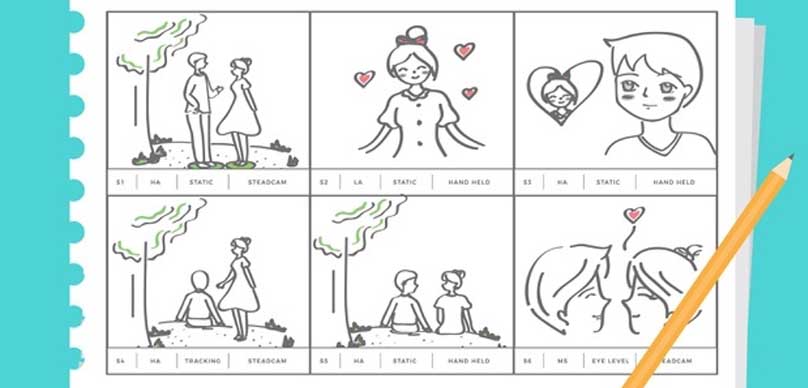
Today we are doing storyboarding, which is one of my favorite parts. Because you’re making the movie before you make the movie. I absolutely love it. We tried to capture the whole process of making those boards to show you guys so let’s not delay any longer Shall we jump right into it.
So I’m working on storyboards.

Now we’ve been working on it for a while. First, of course, comes a shot list and things like that. And once I have a clear vision of what I want the thing to look like, it’s time for me to board now storyboarding isn’t a completely mandatory thing for you to do. There are some directors who don’t most do storyboard. Some don’t do it before time, like Ridley Scott will board what he wants to shoot that day the day before or on the way into shoot the actual film, but some will board way in advance and get really detailed with it. I’m the type of person who likes to board every single shot in the film.

The reason I like to do this is because I set such a clear plan before time I make my entire film before we ever step on set. And by doing that, it is really easy for me to throw everything out the window when I want to because there’s a clear plan in place, I don’t have to be stressed out or constantly thinking how I’m going to do the next thing I have something to fall back on and this structure to work off of.

So I can really get creative and do whatever I want. After that. So when I bored before, anytime I would do storyboarding before, I was always doing it by myself, I didn’t really have a budget or the network to bring somebody in to help me do storyboarding. And you can do that if you don’t have an artist or you can draw, you can still do your boards or stuff like taking pictures, and making your storyboard through pictures.

There’s an app on iPhone called cinematic, which we’ve talked about on the show before which is awesome and has everything you need to make a storyboard. Just go around your house with your friends, getting the clear idea of what it is you want your film to look like. It’s really, really helpful, especially when you’re working with a crew to be able to just show people not try to explain but actually just show this is what I’m talking about. Another great one is frame forge 3d. That’s an awesome program where you can actually find your shots.

And once you have your shots set up, it also makes camera plots for you. You can do different frame sizes, you can do different lenses, you can also get all the measurements, if you know where you’re shooting, you can get the measurements of the room and build it exactly, you’ll know all the heights of your camera. And what I love most about frame forge 3d is the fact that you can find shots this way.

Like it’s a great thing to just move the camera around this virtual world and find the exact shot you want to come in zooming out, you can really learn different focal lengths and what what they’ll make that scene feel like so there’s a lot to that program that’s really beneficial. But with this one, I really wanted to work with a storyboard artist because I was convinced by Fred Dan that that was the way to go when you’re directing, especially with your first big project working with a storyboard artist, he says is the first time that you direct your film, and I gotta say he’s 100% right, having to give my vision to another person verbally for them to put it down visually, has really helped me I mean, I’ve had to justify shots and the way a scene played out, that made me completely rethink the scene because I was wrong.

Once I was seeing it there. And I was explaining why one moment happened to the next, I found out that this was something I was gonna change on set. And given that we only have a certain amount of time to shoot, we’re having a crunch crunch our days, because of the budget, we got to keep the budget down. But working with so many people to find that issue onset was something like this would really be difficult for the production, I mean, something like tell or losses, that’s fine, we’re there with a bunch of friends, it’s not that big of a deal.

But something like this, I really need to make sure all my stuff is locked down. And when I get on there, I know exactly what I want. That way I have the freedom to move around a little bit if I want to. So having Jordan who is the storyboard artist I used, write, draw up the boards and even give me ideas for things was really, really helpful. They bring out they want it I talked a lot.

There was a lot of explaining but now on day three of boarding, which is, I guess 18 hours into boarding. There’s kind of like an unsaid language happening where she totally gets my style. And now I just kind of get the idea of what the morals but I just watch her rip what’s in my head directly out and draw it into a frame. But again, these boards don’t need to be super detailed.

I mean, Jordan isn’t even spending a ton of time to make this look like a comic book. It’s just what you need to get the detail across of what you’re trying to do. I mean if all you’re doing is drawing stick figures and it still gives the idea of perspective and composition. Well then you have yourself a storyboard and I think it’s really important especially when you’re shooting a film. Because you’re shooting completely out of order, you’re all over the place. This helps you retain your original intention of what you wanted for that scene what you wanted the camera to do.

Because in pre production, you have all the time in the world to really dive into your script and figure out what you want your audience to be filming, when you’re on set, it gets really stressful. And it’s really easy to forget where you’re at, under that sort of stress. But with a storyboard, you can easily just go look at the image. And it all comes right back to what you originally wanted for that scene. So it’s really a kind of a safety net, to ensure that what you originally wanted, is still going to find its way to the film.

Another thing that I thought was interesting that I hadn’t thought of before was the actual location we started boarding before I found my locations. And once I found them, we actually redid a few boards, because I had to redo my shot list based on the location, some things when it worked, then I was able to show my artist, some images of our location. And she started tailoring her images to what the location actually looked like, which was really going to help us once we’re there, we know exactly where I wanted the camera, originally, thanks to the storyboards. And it helped us see what we were able to actually do with the camera and not since we know what sort of obstructions are actually in the scene.

Now if you can’t see the location first, it’s really not that big of an issue. The storyboard is still going to help you to know what sort of thing you want. And so you can easily rearrange your shot based on the location you have still getting all those ideas and punctuations that you had in the storyboard. So here’s how it worked. First of all, how did I find a storyboard artist? Well, I just searched the internet, I googled storyboard artists, and then around my location, and I spent days looking for people that I think would be down to do it, that wouldn’t cost a ridiculous amount of money, what you can do is look for people in art school, if someone’s actually still in college, they’re going to be down to do your project desk, just to have a credit just to get experience, it’ll probably do it for free. Of course, it’s nice to give them any amount of money you possibly can. But most of these people in these art schools will probably just hook you up for free, and they’re going to be very, very talented people.

Now, when I met up with Jordan, of course, we start going through the boards one by one starting from our first shot. And I actually went through the script in chronological order. So jumping from scenes back and forth, so I could kind of see my movie layout in front of me, I would describe the shot and draw very, very poorly on a notebook to try to express what I’m trying to think of what’s one thing that helped us a lot was doing Google Hangouts, since I’m in pre production, I couldn’t meet that much. So we would do Google Hangouts, and you could do a screen share. And I was able to show her my screen with frame for Janet, and then position the camera to kind of kind of give her a general idea of what I wanted to do.

And she could go off that. So frame forge really helped me out there too. So the first thing she does is thumbnailing, which is just these really basic, really sloppy images to where only her and I can really tell what that is, then she’s gonna take that back, and then she fixes it up to the second round of roughs. This is a lot more intelligible, you can tell what you’re looking at, it gives me a clear idea of where the camera is perspective and angle.

And then once I approve all those, or have corrections, move up, move down, left, right, I’m very picky about because I want everybody to know exactly what I wanted, she goes back and she makes the final boards, including shading and everything else that really captures the tone for the rest of the crew to see, which is why I’ve been really loving using an actual artist. Because not only is the angle that I want in there, but the actual tone is being represented for people to be able to see there’s also a side to storyboarding that’s kind of like screenwriting. Whereas screenwriting, there’s a secret language to it, that formatting kind of shows someone that the person writing knows what they’re doing, since their formatting is correct, well, storyboarding does have something similar to that. And that is the way that it shows how a character is moving or the cameras moving in and out.

So the usual way that you show the different camera moves is just drawing arrows with usually the cameras written inside them. But for something like zoom, you want to show like the zoomed out version. So this larger frame is where it starts. And the smaller frame is where within and then just draw on the arrows to show the direction of the zoom. So for the reverse zooming out, you do the same thing, you show where it starts. And then you show where it ends, these chunkier arrows are usually what you use for camera moves, there’s like, as you can see, there’s kind of an infinite amount of shapes that you can have the four character moves, what you want to do is use these like skinnier arrows, just so you have a difference between the two. And you can tell what, what the arrow is talking about. So if this guy is going to move this way, you want to draw a little arrow that’s going that way.

I mean, really, what a storyboard is going to do is keep you on track. Like I said, when you’re on production, it’s a little bigger, more than you’ve ever handled before. And it’s crap hits the fan, you start getting crazy stressed out, this is going to help you keep in mind your original intention of what you wanted, and get everybody else on the same page with you. Now if you’re looking for a storyboard artist, you could always use the storyboard artist I used you she can be found right here. She’s incredibly talented, and she’s not going to rip you off, which is nice.

She also has a Twitter right here that you can follow and you should follow because she is quite talented. But that’s it for today. I hope that was helpful to you guys. And of course, again, if you don’t want to draw the thing you can use frame forward, you can use Cinemax, you can just use pictures if you want however you want to do it. Just the idea is to put your vision on paper for you to keep in mind and for everyone else to see. But now, back to the rest of this pre pro and I’ll see you guys next week.


You know, when it comes to camera angles in framing, the full shot or full body shot includes the feet and the frame. For this type of shot, remember to never cut off just the feet. In fact, it’s bad practice to cut off your subject or your knees and below, made look like you basically did it unintentionally or by mistake, like you can see here. It also just looks awkward when the person’s legs are cut off below the knees. Now this, in fact, is not a rule by any means. In fact, I don’t really think there are any rules and film.

But it’s just, you know, bad practice. If you’re going to frame your subject like this, then you better have a good reason for it. Otherwise, it will just confuse your audience and will just simply look like you don’t know what what you’re doing. So basically, for full body shot, you should, you know, stick to something like this. next shot is a medium full shot, that’s when you go in a bit closer, and it’s usually also when you cut off your subject somewhere in between the knees and the waist. And once you frame up above basic the waist area, that’s called a medium shot.

After that, we move in for a close shot that frames from around the breast area and app. And then this here is a close up view which basically frames mainly just the subjects head. Once you move in even closer where you start to cut off the forehead or the chin. That’s usually referred to as an extreme close up, even once you move in to just frame the eyes, for example. Now what you got to remember is that there is no standard by which to go when naming these types of shots. These are simply the names that I use.

There are others out there that use different names. What’s important is that you know what type of shots you want to get. So you know, when you’re planning your shots or doing your storyboards, you always use the same names for the shot type. So you basically don’t end up confusing yourself later on down the road when you go back to look at your notes or your storyboards. And next we’ll talk about the types of shots or angles like over the shoulder or a two shot. These are most commonly used in a scene where two characters are talking to each other.

The shots refer more to the angle than what the exact framing is, for example, you can have a close up over the shoulder or a medium over the shoulder like you see here. And you can even go to a full body over the shoulder. Same goes for the for the two shot. Here we have a full body to shot and then a medium to shot. And then a close up to shot.

Or you know you can also have a three or four shot or whatever and and depends on how many characters you have in your shot. Other shot types you might hear about are an insert or a cutaway, which is basically a close up on a part of the scene or you know, could be a POV of one of the characters we’ll be seeing basically a certain detail in that scene like we see here, where one of the characters passes the car keys to the other. And many times people ask me what size lens should they use to get, for example, a good medium shot?

And really, there is no one correct answer. The types of shots or the framing really have nothing to do with the lens. For example, you can have a medium shot that’s shot using a wide angle lens, such as this 16 millimeter Canon lens that I’m using here. Or you can have a medium shot that shot using a 50 millimeter lens.

Same if you use 100 millimeter or even a 300 millimeter telephoto lens. They all produce medium shots. But of course, each of those lenses gives that shot a different look and effect. The framing doesn’t change. It’s just a perspective. So remember that shot framing has nothing to do with the lens size. And the only way you’ll ever really know what type of lens to use in your scenario is once you have a lot of experience going out there and filming, you know, just trying out different types of lenses and experimenting, then you know afterwards, you should come home and compare what kind of effects you got using various lenses on different types of shots.

Because there’s virtually an infinite amount of effects that you can get when you’re mixing up different types of framing, shot types, angles and lenses. For example, let’s take a close up and do a few versions of it and see what kind of effects we can get. If we were to use a mid sized lens such as this 50 millimeter, then you would get something like this, you know an average type of kind of looking shot.

But for example, if you’re filming, let’s say a comedy and you want it to show a person you know in a funny way, then it might be better to go in and real close and use a wide angle such as the 16 millimeter lens, which will make your subjects features look a bit distorted or exaggerated. It’s not actually the lens that makes your subject look that way but your relative position to the subject.

Basically, the closer you move to subject the more dramatic the perspective will be. But obviously you got to use a wide angle lens when shooting this close. Right now we’re about two feet away from the subject. Now if we were to use a 15 millimeter lens at that same distance, then the perspective doesn’t change. But the framing obviously will, because we’re basically just zooming in. So all you end up seeing is this, it will be the same view look at this shot that we got using a 16 millimeter lens, and then digitally zoomed in. The only difference being that the depth of field will be the same as the 60 millimeter lens. And of course, we end up losing a lot of the resolution, which is why we use different lenses.

Or if you’re using a camera that doesn’t have interchangeable lenses, then you would simply zoom in or zoom out. Now let’s take a look at a full body shot. To get it with a 16 millimeter lens, we have to move away from the subject a few more feet, if you were to move away from your subject to about 250 feet, and this wide angle might be good if you’re trying to get let’s say a wide shot of the location.

Because your subject is so small that it’s really hard to even see him. So that’s when you do want to use a long lens such as this 300 millimeter to basically zoom in. Now when you’re this far away, that’s when the subjects will look more flat and less exaggerated. Since you’re seeing all the features from pretty much the same perspective. It will also bring other surrounding objects such such as this mailbox that we have there in the background, closer to our main subject.

Whereas if we were you know, a bit closer, and let’s say using a 50 millimeter lens, it looks like that mailbox is a lot further away. They’re both the same types of shots, a full body shot, but what changes now is our relative position to the subject. And since with the 300 millimeter lens, we have to move away so much further. And then zooming optically, we end up also zooming in on the mailbox, which is why it makes it look like it’s basically a lot closer to our subject. And then for example you can see in this full body shot that we got using our 50 millimeter lens.

So anyway, next time you’re wondering what lens you should use in your setting, just simply go out there with your camera test all different lenses experiment, and above all, just have fun, because that’s really the best way to learn.


In the logo, you know, I feel like every time that I look up storyboards and how they’re supposed to look, they always look really nice. And I used to think that to do them properly, you actually had to be a good artist, which I am the exact opposite of, which I guess is just a bad artist. But today I’m going to show you the basics of doing storyboards and show you that I can do them, anyone can.

storyboards are done so that you can visualize your film scenes before you actually shoot them, which is a huge help to have on set, it makes your life so much easier, it’s a lot harder to forget to get a shot or you know, not get coverage or a certain insert shots that you wanted to have. And you just forgot while you were on set, it’s a lot harder to do that when you have a good visual reference on set.

And you know what the final product needs to look like. And there are some amazing storyboard artists out there like really good to the point where you feel like you can already see the final look of the movie when you look at them seriously, really amazing people out there. But if you’re like me, then you are not one of those people. I mean, this is how I drew Griffin. It’s like a preschooler with not a lot of talent.

But you don’t need to. But you don’t need to be really good at drawing to be a good storyboard artist. The important thing is that you can interpret what you’ve drawn, and that you can effectively translate them into the images, you want to demonstrate just how bad an artist you can be and still make this work. I’m going to use a few very quick excerpts from the short film script that I’ve been working on and no laughing all No.

Now, as you can see here, that’s supposed to be the cabbies head in the foreground, that is William in the mirror, those are supposed to be the buildings that’s supposed to be the street. So as you can see, I’m not very good. I just make it so you can identify the characters like I know that that’s William in the backseat, because of that really well drawn cowboy hat that’s on him. It’s pretty still shot.

But alongside your storyboards, you can add notes that tell you things like the lighting in this case, I wanted Williams faces and shadow now I already sort of shade it in his face to get that across. But just so that people understand that if they look at this and can’t quite understand what I’ve drawn Williams face and shadow except for brief flashes from exterior light. You can also say the action that’s supposed to take place cabbie, adjust the mirror, I’m not drawing a really bad arm reaching up. But you know, it will be understood that that happens in the shot.

Here’s a line from later in the script. Now he kind of does the dramatic turn back like and says line. Now if you want to show on screen movement, you can use arrows within the frame. In this case, I’m showing that his head is turning around but not his body. You can use this for anything, you can use it for walking, you can use it for any small movement that you feel you can animate just using an arrow, you can do that.

Now on this shot, I also want the camera to push in. Now I could draw a second closer picture to show that that’s what I want to have happen and then just label it accordingly. Something I’m going to show in just a second. But in this case, I can show that the camera needs to push in just by doing this, I’ve drawn what the final framing will be these arrows here show that the camera will push in that just to show that it’s a push and not zoom again down in the notes camera pushes in from medium to close up.

Now I’ve got the shot where the car full of the thugs is driving up slowly. And they’re all looking away from the camera out of the parking lot and the building in the background. Looking for a particular car. Now I drew the worst car ever. But for the actual framing, I wanted it to be tighter. So I’ve adjusted the frame accordingly, you can actually draw the rest of the picture and just keep the frame for visual reference as to how it’s supposed to look when it’s shot. And again, I want the camera to move. But this time I’m not, you know pushing in or zooming in. But I actually just wanted to track along with the car. This is easier to get across if you use arrows that kind of crossed the line from outside the frame into inside. And in this case, just for reference, I’ve written track, that is pretty simple. Drawing a car is not as simple for me.

Now this is if you have one long shot, but you want to show multiple frames to show what the action is going to be. This one is going to be a shot that starts off on the ground showing the door of a car opening the legs stepping out of the camera pushes in and raises up and shows the character of William they’re raising his gun and about the fire. Now as you go through your storyboards, you should number them. And if you have multiple frames for the same shot, you just label it one a or whatever number a than B and C etc. And that’s just a few brief storyboards for me but they’re good examples of what you can do when you really can’t draw. But you do have other options if it’s a quicker shoot and you just sort of quick notes on how things need to look.

You can actually do small thumbnails in the margins like this one here, which was just going to be a two shot of the two characters in the cab and I didn’t need to do anything fancy. I just show the two characters are sitting alongside each other face in the camera. That’s the framing, nothing fancy but it’s good to have on set if that’s all you can do. Some people don’t like to completely visualize that they just like to make a shot list. They have a list of shots that they want to get like extreme close up, insert and master shot and they’ll just in writing describe what they want.

And those can also be put in the margins there also pewter programs that you can use that you can make digital art storyboards. And there’s quite a few out there if you don’t even want to touch pen and paper. And it doesn’t always have to be as messy as what I’ve done here. So if you want to look a little bit more professional, you can find templates for storyboards, and shot lists and all that online. And that’s really it. For me, again, I’m not good at this. I’ve said that 100 times at this point, but you don’t have to be, you just need to be able to translate your images to the screen.

And when we actually start shooting the short film, we’ll come back to the storyboard and see just how well I was able to capture that. And another thing you can do that Robert Rodriguez actually does is that you can actually just go on set with a camera and just sort of video storyboard with your actors, have them stand in their spots, get an idea of what you want it to look like and just leave it at that. That’s one of the videos we’re going to be showing in the playlist at the end here is a little featurette on how he does his video storyboarding one video I couldn’t find anywhere online, unfortunately.

But if you have the seven DVD you should check it out. There’s an alternate ending where all they had was the storyboards and they had actors do voiceovers and they sort of animated it, which is called an animatic, which is a whole other thing for another episode.


I know what you’re thinking Mad Max, a comic book film. What enough is this guy talking about? Well Hear me out for the entirety of this video and then just maybe you too will see how Mad Max Fury Road is an unconventional comic book film. Everything that we’ve seen on screen and Fury Road is largely practical effects. We’ve all heard the story about how George Miller and his crew wanted the film to feel tangible and truly kinetic and energy. But what if I told you that 80% of what we see on screen was recreated from 3500 panels of comic book style storyboarding?

In fact, take a look at this. And now this, Miller and his team of artists worked tirelessly for two years drawing out the entire film before even putting any dialogue to paper. It’s important to note that these are genuine panels almost as though they could be printed instantaneously and passed off as comic books for many films on the go to storyboard process.

Very few do so without actually knowing the dialogue they are working off Fury Road was conceived through art and sketches. And if we continue to view the side by side shots of the panel and then the film, it almost feels like a pulpy comic book adaptation, something similar to this perhaps. From an artistic standpoint, the whole visual and feel of Mad Max would not look out of place if say, US DC or Marvel logo slapped in the opening credits of it. In fact, Fury Road is the greatest superhero film of this decade.

Because yes, let’s face it, this is eerily reminiscent of the world of a superhero. And it all starts with Furiosa. Our protagonist could easily be compared with Batman, for example, her parents of dad she rose this vast world alone and effectively by the end risks her life to better and protect that of the people around her. She even has a trusty sidekick, Max. that camaraderie and short could be conversations but yet another strong facet of this forms layered comic book style nuances. While the dialogue is minimal. This only adds to the sheer hilarity and sometimes cheesiness of it all.

Mila himself had this to say about the dialogue, or something which was pretty nonverbal. I mean, people obviously speak in the movie, but they speak only when it’s necessary. And I think that quote is super important, especially as it’s a way of prioritizing the images as vivid replacements of words. There’s the often spout cliche in screenwriting, where you can paint a picture with words for Fury Road almost subverts this, as this pictures evoke words. Instead, the minimal dialogue has its roots deeply ingrained in the comic book style, with Miller storyboards, even after the script containing zero words. Another little nuance which solidifies Fury Road as a somewhat unconventional comic book film is the character names.

They don’t usually feel like real people almost as though these are their aliases. alter egos. Furiosa max rocker tans be immortan Joe slip knocks, the list goes on. And the comedy for he’s pretty awesome.

It almost establishes an idea of hierarchy as the longer name characters are often the most powerful. Meanwhile, those with shorter names are more expendable. The names alone concoct this world that feels as though it exists in a realm of imagination. Get the images much like Gotham and Metropolis remind us that this is a world like ours where if something goes wrong, we could very well end up inhabiting it’s almost cautionary in a way I live in comparison. swampthing in the both deal with nature and the environment as a rustling of society.

The point here is in the Mad Max is ripped off these comic book arcs or films, or was even influenced by them, but it’s simply a fun anecdote that helps this action epic operate as a quasi comic book film. On the topic of characters Fury Road also delivers the brutish villain in in Walton Joe, a man hungry for water and oil depriving everyone of natural resources for his own presidential like power is cold season Come on the wall boys into giving up their lives for him if need be. In return, he promises them a birth in the afterlife of Valhalla.

We’ve seen this type of manipulative and power hungry villain and the likes of Green Goblin and many Spider Man arcs or the Joker and His endless band of goons, the myth and legend of immortan Joe makes him as compelling as the best comic book villains to even has that stereotypical muffled voice of the comic book villain like say Bane, for example.

And as a side note, Fury Road has recently been turned into an actual comic book series. It may not explicitly be a comic book or superhero film, The Mad Max Fury Road toys so heavily with elements of the two that it might as well be and if it constitutes as one then it may very well be at the top of many lists as the best. Hey guys, I’d like to thank you all for watching the video.


Storyboards are illustrations that represent the shots that will ultimately make up a movie. They allow you to build the world of your film before you actually build it. There are any strict exacting rules on how to do storyboards conveying information is what’s important. storyboards are ultimately a technical document a tool. So it doesn’t matter if you’re a skilled illustrator or not. This can work just as well. Is this a way they could take care of? Yes, no problems. I’ll put them on my cat.

Even if you struggle with the perspective or can barely draw a stick figure you can still convey what types of shots you want and their basic composition. Who storyboards typically, the director sits down with a storyboard artists to help articulate their vision. However, it’s not uncommon for cinematographers and production designers to join in the process as well.

I usually meet with the director and produce rough thumbnail sketches that summarize the important information each panel and then afterward I’ll fill in the details on my own meeting with the director once again after completing the panels to make sure everything works. Well then share the completed panels with the rest of the team. Let’s break down the parts of a storyboard.

The panel or frame is a rectangle that represents what the camera will see. panels come in a bunch of different shapes. Pick a panel shape that matches your shooting aspect ratio square widescreen, really really widescreen. A person drawn really small on the panel is a wide or establishing shot. A big head taking up half the panel is a close up. You’d like them. deciding where you put the person your frame is the basis of your composition. This may seem really basic, but this has a huge impact on how you prepare for your shoot these illustrations give your cinematographer a starting point things like camera angles, lighting, depth of field the whole gamut of decisions can be informed by the storyboards.

It’s also a great way to decide what you’ll need out of your locations. Do you really need a giant bottomless pit? Or can you get away with one visual effects wide shot and then cover the rest and tighter shots? Okay, let’s talk about arrows. So now that we have a panel with a character in it, let’s say that character is moving to the left by dragging an arrow pointing to the left we show where that character or door or dinosaur is moving. There’s no real rule to drawing arrows and everyone has their own personal style. But what’s important is that your arrows are easy to read and make sense.

Here’s some examples of arrows. Arrows for characters moving towards camera arrows for characters moving away from camera, this character is kneeling down, and this character’s head is falling off. Arrows within the panel usually mean a subject is moving in the shot arrows around the edges usually imply some sort of camera movement. So here the Raptor lenses right, and the camera pans left.

Now let’s talk about camera movement. camera movement. Arrows also aren’t really standardized, but let’s go over some common ways camera movement is illustrated. Dolly movements are typically done with one arrow often narrowing a little bit to suggest movement in or out of 3d space. Both Dolly shots and zooms can also be illustrated by placing arrows in all four corners of the panel. This shows a widening or narrowing of perspective, you can draw a panel within your panel to show how far your dollar zoom goes.

Clearly conveying information is key. So it’s better to over explain than to confuse people. Hands are often shown with an arrow on the side of the panel, either pointing to the left or to the right tilts up and down are done much the same way. Except with the arrows at the top or bottom of the panel. You can also elongate the panel to fit the entire shot in a single drawing.

Since this can get a little confusing, it’s okay to make a note indicating whether or not the shot is tracking versus panning or dollying versus zooming. Because arrows are often used the same way in both instances, you can make your notes beside the panel or in the arrow itself. Sometimes you’ll need more than one drawing to illustrate what’s happening in a single shot, especially if it’s a really complicated action or camera movement. When you take panels with angle composition on screen movement and camera movement, and then combine these panels into a sequence, you have the foundation of your movie
storyboards are pretty Pick really useful for preparing scenes that require multiple effects techniques.

For the scene from truck flipper versus bus puncher, we use storyboards to decide what was going to be stunts, what was going to be practical onset special effects, what was going to be green screen and what was going to be CGI based on exactly what kind of action was needed in each specific shot without planning ahead. A scene like this would have been impossible to shoot in the amount of time we had available. storyboards are typically created based off a completed script. But if you’re doing a story that’s extremely visual storyboards essentially can be your script like with Mad Max Fury Road.

Since it’s such a visual film, the beats were more effectively planned out with pictures than with text on a page. While this is an extreme example, this holds true for preparing all visually complex scenes. There’s also plenty of other alternatives to storyboarding, Stanley Kubrick used actual photos from his location scouts to find his compositions. It’s also worth mentioning that filmmakers who’ve adapted comics and graphic novels often use the original artwork essentially as storyboards for the final film, you can make animatics of your sequences on your computer to include motion and timing. You can also videotape your prevas which is really useful for complex action.

You don’t need the actual set costumes or magical flying speeder bikes to test out your ideas. In the original Star Wars, George Lucas used real world war two documentary footage to help pre visualize the space battles headache.

Animation has also been used to help capture complex sequences, Jurassic Park, you stop motion animation to pre visualize the dinosaur scene. When the decision was made to use CGI in the final film, they had already planned ahead and painstaking detail and knew exactly what specific movements the CGI was going to need to be able to do.

By the time Peter Jackson did the Lord of the Rings trilogy, digital technology had developed to the point where they were able to motion capture the cave troll sequence, and then move a digital camera around in 3d space to pre visualize the entire scene in a virtual setting. There’s no hard and fast rules are one way to do it. But the ultimate goal is planning and clear communication. So whatever tool is going to help you prepare and share your vision the most use it it’ll pay off when you get to set and will help empower you to make the best film possible.

What the Heck is the 180 Degree Rule? – Definition and Examples

You might hear on set a DP or camera guy to discuss the 180 Degree Rule and say:

“You can’t put the camera there, you’ll cross the line”

There’s a lot more to shooting a great scene than just planting a camera somewhere and yelling action. We all want to shoot a scene that can be cut together to achieve great continuity with a good variety of shots.

The 180-degree rule is a cinematography guideline that states that two characters in a scene should maintain the same left/right relationship to one another. When the camera passes over the invisible axis connecting the two subjects, it is called crossing the line and the shot becomes what is called a reverse angle. Reversing the angle is commonly thought to be disorienting and can distract the audience from the intent of the scene.

The videos illustrate the basic principles of the 180-degree rule, establishing action lines, working with shifting action lines, and redefining the action line using neutral shots, camera movement, and cutaways. Knowing how to apply the 180-degree rule, and when you might want to break it can take your production skills to a higher level.

SHORTCODE - SOUND FX

Need Sound Effects for your short or feature film project?

Download 2000+ sound effects designed for indie filmmakers & their projects for free.

I broke the 180-degree rule in my film This is Meg and all is OK. I knew the line was there but made a call and it worked out perfectly. You just have to understand the rule so then you can later choose to follow it or not.


Spoiler

Transcript for Moviemaker Video:

There’s a lot more to shooting a great scene than just planning a camera somewhere kneeling action. We all want to shoot a scene that can be cut together to achieve great continuity with a good variety of shots. But 180 degree rule is a useful tool to help you achieve this. In this segment, we talked about the basic principles of the rule, establishing action lines, working with shifting action lines, and redefining the action line using neutral shots, camera movement, and cutaways. Knowing how to apply the 180 degree rule and when you might want to break it can take your production skills to the next level.

The basic idea behind the 180 degree rule is to establish and maintain the screen direction of your actors or action in the scene. Failure to follow the rule can make scenes difficult to follow for your audience. The most important factor in working with the 180 degree rule is knowing how to establish a line of action. The line of action is an imaginary straight line that is drawn between a subject and an item or person they’re interacting with, or a straight line drawn along a path that a subject is moving on. Let’s look at two actors position for a dialogue scene.

As an example, if we look at the scene from overhead, we can draw a straight line from actor one sight line to actor two’s. This is our line of action for this scene. The 180 degree rule states that once you place your camera on one side of the line, you should keep all your shots within the 180 degree arc on the same side of the line in order to maintain proper screen direction.

When you first introduce a scene, you’ll typically have an establishing shot to help orient your viewers. The establishing shot gives the viewer the basic geography of the scene and determines the screen direction of the actors or action. This is the establishing shot for our scene, an actor one faces screen right and actor two faces screen left. As long as the camera doesn’t cross our action line, our actors sight lines stay consistent. This prevents the viewer from being confused or disoriented. In contrast, if we cut to a shot that has the camera placed on the opposing side of the action line, our actors are now facing the opposite direction and their sight lines will not match up properly.

Taking a look at the two shots in Split Screen clearly demonstrates the concept when shot properly are actors look toward each other. When the 180 degree rule is broken, our actors no longer appear to be looking toward each other. We can also apply the 180 degree rule to action, such as a person walking, let’s take a look from overhead. We can establish our line of action by drawing a straight line in the direction he is moving. If we place our camera on this side of the action line, our actor will be moving from screen left to screen right, we can change angles freely on the same side of the line without altering the screen direction of the actor.

If we were to move our camera across the line and cut to that shot, it will appear to the viewer as if the actor is traveling the opposite direction. This holds true for cars as well. And it’s extremely important in sports as you don’t want to have a player running toward the goal line, then cut to a shot that makes them appear to be running the opposite way.

Of course, you could break the 180 degree rule for dramatic purposes if the story supports it. If your character is disoriented or lost, it can give the audience the same feeling. So we’ve learned how to establish the action line and what happens when we break the 180 degree rule. Now let’s talk about movement within a scene that can cause the action lines to shift. If your scene has movement that will shift the action line, you’ll want to have a basic idea of which direction you’d like to shoot. Let’s take a three person dialogue scene as an example.

Here’s an overhead shot of the setup. Our initial action line is between actor one and two, because they will begin the scene by talking to each other. But once actor one turns to actor three to speak, our action line will shift. We’re going to establish our scene by placing the camera here and try to keep this initial point of view in mind when our action line shifts.

This means we’ll shoot from this side of action In line one, and this side of action line two, the key to making this work is showing the action that shifts the line. In this case, we want to clearly see actor one change his sight line from actor to to actor three. Once we’ve shown the turn, we can now place our camera anywhere along the 180 degree arc of the newly established action line. Now let’s have actor two and three turn to each other to talk. Looking at the overhead, we can see we now have established another new action line.

Based off our initial view, we choose this side of the line. Again, we must show one of our characters turn his head to establish our new action line. Once we’ve done that, we’re free to get shots on the proper side of the line. While something as simple as an actor changing his or her eyeline can shift the line of action, and actors movement can cause the line to shift as well. In this scene, one of our actors begins to walk off, then turns back toward the other. By changing their position, they’ve also moved the line of action.

And now a camera position that would have caused a screen direction shift is well within the newly established 180 degree arc. You can also intentionally create new action lines by using camera movement, neutral shots, or cutaways. In this scene, we’ve established our action line, but we want to transition to the other side of the line. One quick way of doing this is to show the camera breaking the line. As we move past our actor, our audience is now reoriented to the new screen direction, and we’re free to cut any shots that fall in the 180 degree arc of the newly established line. You can also use a neutral shot in order to reestablish an action line.

A neutral shot is obtained by placing your camera on the action line itself, which allows you to then cut to shot on either side of the action line. In the walking example, we could cut to a neutral shot of the actor walking directly toward the camera, which is on our action line. This frees us to cut to a shot on the other side of the action line without being disoriented.

A third way to establish a new line is to use a cutaway shot. In this example, we might use a shot of the surrounding landscape followed by a shot taken on the opposing side of the action line.

Keep in mind that each time you establish a new action line, you are now locked into that 180 degree arc until the line shifts with your subjects action camera movement for specific camera shots. Creating a scene with well selected shots and great continuity is a crucial building block to telling effective stories with video. By understanding the 180 degree rule, you can shoot and edit your next project with confidence and style.

Watch: Robert Rodriguez’s The Director’s Chair (Film School)

Robert Rodriguez is an indie filmmaking legend. His book Rebel without a Crew: Or How a 23-Year-Old Filmmaker With $7,000 Became a Hollywood Player is required reading for any filmmaker. From the mythical El Marachi to Sin City to Alita: Battle Angel Robert has done it all. He even owns his own network, El Rey.

If you are a filmmaker and watch El Rey you need to be watching Robert Rodriguez’s amazing show The Director’s Chair. The Director’s Chair is an hour-long series by Robert Rodriguez featuring the industry’s most notable directors as they engage in a revealing and unexpected exchange about the world of filmmaking. The series provides a forum for two directors to go one on one, offering viewers access inside the minds of some of Hollywood’s most iconic filmmakers.

I’ve gathered most of the episodes available on-line. Each episode is like a semester of film school. Robert interviews directors like Quentin Tarantino, John Carpenter, Sly Stallone, Francis Ford Coppola, Guillermo Del Toro, Robert Zemeckis. George Miller and Michael Mann.

Get ready to have your mind blown! Enjoy.


The Director’s Chair – Episode 01 – John Carpenter

The Director’s Chair – Episode 02 – Guillermo Del Toro

The Director’s Chair – Episode 03 – Quentin Tarantino


The Director’s Chair – Episode 05 – Francis Ford Coppola

The Director’s Chair – Episode 06 – Luis Valdez

The Director’s Chair – Episode 07 – Robert Zemeckis

The Director’s Chair – Episode 08 – Michael Mann

The Director’s Chair – Episode 09 – George Miller

The Director’s Chair – Episode 10 – Sylvester Stallone

The Legacy of Quentin Tarantino’s Death Proof

Only a handful of directors knows how just to catch the attention of people like Quentin Tarantino. No doubt, he is good at doing things right. Considered as an exploitation film that stroked the sensibilities of genre nerds, the theatrical release of the double-feature throwback experiment is seen to both confuse and alienate the general moviegoing public at the same time.

Quentin Tarantino and Robert Rodriguez’s Grindhouse was released on April 6, 2007. The directors made an intentional affectation that got many unsuspecting patrons unhappy. The saw the nicks and scratches in the film as damaging. As a result, the confidence of the filmmaking duo began to wane when disappointments from general disinterest and the resulting box office came filing in.

While some may consider the gritty, 70s-style exploitation flick to be one of Tarantino’s purest movies, there is a good number of viewers who are still wondering where his contribution was. When credits of “Planet Terror” – Rodriguez’s lead film – starts to roll, these were the people who pulled on their coats and obliviously left the theater all because they felt deceived.

Up to this very moment, the film –Death Proof – still carries along a raging debate with lots of disapprovals from the viewing public. Even as a major part of the filmmaker’s broader legacy which was meant to serve as a standalone entertainment, the film generally appears to be a far more contentious piece.

While some may find it hard to gauge the lasting effect of the movie, a good number of fans – both the obsessive and casual ones – consider the 2007 American exploitation film as the worst effort of the director by a wide margin.

You can read all of Quentin Tarantino’s Screenplays here.

Death Proof: The Film

Under the collective title “Grindhouse,” the film – Death Proof – was theatrically released as part of a double feature with Planet Terror which was directed by Robert Rodriguez. Basically, it was aimed at recreating the experience of viewing the double features of exploitation film in a grindhouse theater. Though released as part of a double feature in the US, the film got a separate release outside the shores of its home country.

Quentin Tarantino both wrote and directed the film which stars Zoe Bell, Mary Elizabeth, Tracie Thoms, Sydney Poitier, Rose McGowan, Jordan Ladd, Vanessa Ferlito, Rosario Dawson, and Kurt Russell. In the film, Zoe Bell played herself as stuntwoman while Kurt Russell starred as the stuntman. The film pays homage to the muscle car, exploitation, and slasher films of the 1970s. During the 2007 Cannes Film Festival, Death proof was seen to be in the main competition for the Palme d’Or.

Death Proof: Behind the Scenes

Quentin Tarantino was inspired by the way stunt cars were “death-proof” by stuntmen so their drivers could be able to survive horrific collisions and high-speed crashes. It was this fascination that led to the production of the creation of a slasher film that features an upset stuntman with a “death-proof” car which he uses to stalk and kill sexy women.

Apart from women-in-prison films, Tarantino was looking to do a more rigid film. That was when he came up with the idea of using the structure of a slasher film to create something strict that people will love. According to Robert Rodriguez who helped title the movie, the film was simple and straightforward.

In Tarantino’s earlier film – Kill Bill– he had featured stuntwoman Zoe Bell as a stunt double for Uma Thurman and was stunned by her performance. Initially, he thought her role to be a cameo one but it later turned out to be her first on-screen acting. Zoe Bell on her part never understood the enormousness of her role until her name was featured on the film posters opposite other characters like Rose McGowan, Rosario Dawson, and Kurt Russell.

Based on the stuntwoman herself, Bell was selected to play the character, Zoe. In order to make the film look more like the typical 1970 movies shown in grindhouse theaters, the filmmakers sought to employ various unconventional techniques to reflect the style. One way they could do this was to intentionally damage the film. Throughout the feature, the film looked it was in bad shape. This is evident in the hilarious switch in title when the title ‘Quentin Tarantino’s Thunderbolt’ was abruptly replaced by a title card with an inexpertly emblazoned inscription – ‘Death Proof’ – across the screen.

The leading female role was written by Tarantino himself. Basically, he sought to create a kind of a loving homage cinematic sub-culture that many find difficult to comprehend. Viewers who are not used to the “grindhouse” cinema phenomena found it difficult to understand how the film was set out. Both in its look and feel, the film went out of its way to imitate the style of exploitation cinema that was popular in the late 60’s and 70’s.

It would appear that a vast majority of mainstream audiences didn’t find the film at all amusing. This alone led to the major criticisms leveled at it. In the first place, the film is not meant to be taken very seriously. Rather, it was purposed to be a pastiche or a parody of the class of movies a greater percentage of viewers wouldn’t want to see. But in terms of content, theme, and plot, it tends to be highly controversial and little in the way of conventional film logic.

The original idea was to pastiche two films and relay them at drive-in movie theaters as a double feature. As they move from state to state, theater owners will just have to take up the role of the filmmakers to re-cut and re-edit both films. This is the explanation for the appearance of a severely depreciating film stock, the switch between black and white and color, the sloppy editing and the purposeful mistakes in continuity.

Death Proof: The Critics

In a bid to appeal to the obsessive-type movie aficionado who are capable of appreciating the joke and getting the references, the filmmakers try to create a focused adoption of shoddy film-making which is in no wise sloppy as some may see it. To this end, it becomes quite difficult to see what people may be criticizing. A greater number of people would be reluctant to consider sevral semi-unclear movies that influenced the film as they will not actually expect it to keep them enthralled and entertained.

While the rest of Tarantino’s works have received wide praise, Proof’s merits have suffered derisive sarcasm. During a roundtable interview with a Hollywood reporter in 2012, Tarantino was quick to state that he felt the film stains his credit thereby regarding as the lowest point of quality that can be accepted from him.

However, come to look at it, the film seems to contain certain features that can rarely be found in any of his works. Tarantino’s film is such a personal work that’s got his fetishes, self-indulgence, influences, and interests at work. No doubt, everything here including the heavy flaws contributes immensely to the body of work displayed in the film.

Obviously, the movie is the palpable result of the most exciting auteur in cinema. It can be said to be a film writ in his largest, loudest letters. While some critics may see Death Proof as a remake of some cheapie slasher exploitation flicks, others can freely say it is the ecstatic fantasy daydream of the maker after night binging on girl gang.

Apart from Tarantino, there would only be a few people that admire the exploitation in the film. As a matter of fact, most of the features in Death Proof were no classics. Referencing to “vanishing point” is just unheard of. An average moviegoer must have never come across such things as “SwitchBlade Sisters.” No doubt, the movie is unbearably talky.

As part of the pastiche, Tarantino and his crew deliberately insert continuous dialogue that makes it sound chit-chatty with endless gabbing. Those who accustomed with this will find it difficult to understand that the action was deliberate. This was basically done to conserve the budgetary production of the film and at the same time, reference the downside to genuine seventies Grindhouse flick.

Death Proof: The Raves

Outside the meaningless girl talk and the ponderous lulls that can even be forborne, there are still some interesting features in the movie that cannot be overlooked. As a matter of fact, it is hard to deny that the vehicle stunts exhibited in the film are impressive. No doubt, Sally Menke did a beautiful job there! One absolute shocker that cannot be by-passed is the spectacular crash. This remarkable moment alone requires both a ‘pause and replay’ action.

The Jackie Chan factor was fully observed here when Zoe Bell heightened the tension with a sense of actual danger while performing her own stunts. Along with an admirably old-school precision, the climactic cat-and-mouse car chase proved very pristine. As an actress and stuntwoman, Zoe Bell never found the role of playing herself any challenging. Thanks to a sympathetic advantage, she found so easy to showcase her bubbly personality.

Also, the remaining casting is ideal. At first ominous and then pathetic, the renascent Kurt Russell showcases his fatherly charm and charisma into something extra ordinary. He deftly navigates through his role with tonal hairpin turns that are only typical with him. Even Mickey Rourke would have found this role to be quite challenging to handle. No doubt, the twisted ex-stuntman Mike did a great job getting off on chasing pretty women off the road.

Tarantino seeks to upgrade the Mike to the status of a near-immortal by making him literally untouchable especially when he’s in that death-proof car of his. In fact, Stuntman Mike was so elevated that he could not be killed by anyone except in the hands of another stuntman. But in this scenario, there was a stuntwoman.

In a bid to evoke the typical nature of the film’s location – Austin, Death Proof features a soundtrack packed with southern-flavored obscurities which are also part of the director’s favorite. Long before joining the industry, Tarantino has been working as a musical ‘curator.’ So, he knows just how to bring his least-gimmicky and most consistently listenable tune selections into the mix. Just so you know, the director wrote all the song titles used in the movie. As a huge part of all of his films, Quentin Tarantino was able to get his personal 45 collections into the jukebox in the Texas Chili Parlor.

Tarantino is famous for monkeying with his movies’ timeline. But unlike his other movies, Death Proof is the only film that runs in chronological order. Here, he had no choice but to skip the trickery features such as the flashbacks so as to perfectly get aligned with the down-low style of Death Proof. Littered with his personal touches, Tarantino does well to recycle “Death Proof” from thriller materials and stock horror.

Death Proof: Final Thoughts

Towards the end of the film, an amusing but unanticipated change-up occurred when the girls gained superiority over the nefarious Stuntman Mike. This alone is capable of bringing a soothing relief on the face of every aficionado praying for an imminent escape for the girls. No doubt, the girls in tight t-shirts, the other characters, the music, and the colorful iconography added to constructive nature of the movie. All these made it look like a joyous, darkly comic romp.

Apart from attempting to turn its audience on to a whole new world of cult Japanese cinema, Death Proof fully demonstrates to its audience the great use of movement, color, texture, and tone employed by the filmmaker. Nevertheless, the film is meant as a piece of entertainment. The final scene of the movie was shot near the Neverland Ranch, at the entrance to Midland School just on Figueroa Mountain Road.

Sponsored by: Special.tv – Stream Independent 

What is the French New Wave? – Definition and Examples

French New Wave, which is also known as French Nouvelle Vague, can be considered as one of the most influential film movements that took place in the history of cinema. The ripples created by this cinematic movement can even be felt today. A group of critics, who wrote for a French film journal called Cahiers du Cinema, created the film movement.

It began as a movement against the traditional path that French Cinema followed, which was more like literature. The French New Wave had the potential to bring a radical change to French cinema.

Few of the leading French movie directors supported the French New Wave at its inception. They include Jacques Demy, Agnes Varda, Alain Resnais, Louis Malle, Jacques Rivette, Eric Rohmer, Claude Chabrol, Jean-Luc Godard, and Francois Truffaut.

These directors have produced hundreds of movies to the French cinema industry and their involvement created a tremendous impact on the success of French New Wave. As a result, many other French directors were influenced by it, which created an ideal platform to deploy the radical change that the French cinema industry required.

How did the French New Wave movement originate?

The manifesto of Alexandre Astuc, The Birth of a New Avant-Garde: The Camera-Stylo can be considered as the starting point of the French New Wave movement. This event took place in 1948. This manifesto outlined several ideas that were explained by Cahiers du cinema and François Truffaut at a later stage.

They argued that the French cinema was similar to the literature, which expresses the same ideas that are depicted in novels and paintings. In other words, the artists at that time used movies to voice their thoughts. Some of the leading film producers, whose names are mentioned above, wanted to change it and this is the birth of the radical movement in the history of French cinema.

Morris Engel, who was an American film director, also contributed a lot towards the French New Wave. He produced a movie called Little Fugitive back in 1953 as he was impressed with the concept of French New Wave. This film clearly shows how the cinema industry in France got International support to carry forward the much-needed move. The French movie producers still appreciate the contribution of Morris Engel.

During the French New Wave movements, particular attention was paid towards the theory called auteur theory. As per auteur theory, the director of a movie is also the producer of it.

Therefore, the directors took the necessary measures to add a personal signature to the film. The directors who lived in France at that time praised the films produced by Jean Vigo and Jean Renoir because they were pioneer figures who fought against this theory.

They were able to create a few memorable films with the help of talented scriptwriters. The participation of scriptwriters helped them to stay away from adding their personal opinions and views into the movies that they created.

Jean Rouch can also be considered as a prominent figure in the French New Wave. The first new wave feature came out at this point. It was delivered along with the movie Le Beau Serge by Chabrol. The trend continued for a few more years as well, where few other movies such as Godard, The 400 Blows, and Truffaut came out with similar features.

SHORTCODE - SHORTS

Want to watch more short films by legendary filmmakers?

Our collection has short films by Martin Scorsese, Quentin Tarantino, the Coen Brothers, Chris Nolan, Tim Burton, Steven Spielberg & more.

These movies became popular in international film industries in an unexpected manner. In fact, it received both financial as well as critical success. This made the entire world talk about the French New Wave. As a result, a perfect platform was created for the movement to flourish. The characters who took part in the movies that were produced during the radical change were not labeled as protagonists. This created a positive impression on their minds as well.

The auteurs also played a tremendous role during the French New Wave movement. That’s because they received excellent support from the youth audiences. Most of the directors who helped the French New Wave were born during the 1930s. On the other hand, a large percentage of them spend their childhood in Paris.

As a result, they have a clear understanding of how people in Paris experience their life. All-night parties, urban professional life, and concentration in fashion were hugely popular among youth who lived in Paris. These skills assisted the directors to support the movement with radical inputs.

The French New Wave was roughly famous between 1958 and 1964. The movement came to an end by 1973. Even though it was finished at that time, the influencing effects existed for several decades.

SHORTCODE - SHORTS

Want to watch more short films by legendary filmmakers?

Our collection has short films by Martin Scorsese, Quentin Tarantino, the Coen Brothers, Chris Nolan, Tim Burton, Steven Spielberg & more.

The international popularity of French New Wave

As mentioned earlier, many other countries in the world were aware of the French New Wave during the 1950s and 1960s. It created an impact on the International movie industry as well. The big radical change introduced by the French New Wave played a tremendous role in the fact mentioned above.

In fact, the French New Wave was powered up by the social and cultural change that came out after World War II. During this time, some lateral movements also existed in the world. The Free Cinema movement existed in Britain during the 1950s, and the French New Wave even influenced it.

The neighboring countries of France had some like-minded movie producers. They took the initiative to implement the radical change introduced by French New Wave in their countries as well. Most of these young directors were Communist-controlled individuals. As a result, they had the potential to create a tremendous impact on society.

Ivan Passer, Vera Chytilova, and Milos Forman are some of the leading movie producers who lived in Czechoslovakia at that time and took necessary measures to promote French New Wave and its changes to the International film industries. Likewise, few other producers from Poland such as Jerzy Skolimowski and Roman Polanski also contributed towards the global popularity of the movement. Even though these producers wanted to implement the change proposed by the French New Wave, they did not have the required assistance.

As a result, they chose non-professional actors and continued with shooting on location. The French New Wave was popular in Italy as well. Young producers such as Marco Bellocchio and Bernardo Bertolucci were inspired by the radical changes that were introduced by this movement in France. As a result, they promoted those changes within Italy.

French New Wave was not only popular in European countries. It also became a popular film movement in Brazil and Japan. Producers such as Glauber Rocha and Nagisa Oshima made movies devoted to the New Wave as a result of it; this helped them to take international social conventions to a whole new level.

The popularity of the French New Wave in the United States is notable as well. The USA was known as the heartland of commercial cinema. The film industry in the USA had its very own movement, which was led by a filmmaker named John Cassavetes. He gave life to some interesting movies such as Faces in 1968 and Shadows in 1958, which created a tremendous impact on the New Wave movement.

The New Wave movement initiated by John Cassavetes and the French New Wave movement had similarities among them. That must be because John Cassavetes was researching a lot about the French new wave at that time. He must have got some inputs from the French New Wave, which was hugely popular at that moment in time. Therefore, the French New Wave has created an impact on the American movie industry as well.

How the French New Wave Changed Film History Forever

French New Wave took place 50 years back. Now you must be wondering why we should pay our attention towards it. As you can see, the French New Wave has been able to bring some revolutionary changes to the movie industry in France.

Also, it created a tremendous impact on the film industries that existed in many other countries. The result generated by this movement was not only restricted to Europe. It became famous around the world as well and its concepts influenced a lot of directors. These ideas have created the layout for the popularity of alternative cinema, which exist in today’s world.

Without French New Movement, there won’t be Bertolucci, Oshima, and Wenders. On the other hand, advertising, fashion, and music would be done without any major point of reference.

Therefore, the French New Wave was capable of taking the world to a whole new level. It can also be considered as the most revolutionary movement that took place in the movie industry during the 20th Century. Without the New Wave, no film would be open. You would not even like the movies that you can see out there. Therefore, even future generations would appreciate the commitment of the founders of the French New Wave and the influence they created.

Top 20 Best French New Wave Films

Alex Ferrari 0:09
I'd like to welcome show Richard neubert. How you doing my friend?

Richard Neupert 0:13
doing just fine. Thank you.

Alex Ferrari 0:15
I appreciate you being on the show. You know, I've never had an educator, come on the show to talk about a film movement before. And generally speaking, isn't that something I've done? But the reason why I wanted to bring you on was I wanted to talk about all things French New Wave. And I know a lot of people listening Oh, my God, are we really gonna sit here and talk about the French New Wave? We are. But the reason I wanted to bring you is because I wanted to show filmmakers today. What these Renegade filmmakers were doing back then, and how what they were doing can help us today in our new kind of world that we live in, which is these micro budget, low budget, running gun kind of filmmaking, which we now have the ability to do at a much more affordable rate than they did back then. And they were still doing it back then. So before we get started, can you explain to everybody who's never heard of this, what exactly is the French New Wave movement?

Richard Neupert 1:13
The French New Wave was an explosion that really had never happened before. Or since I don't think in motion pictures. A couple of people who were all under 30, which was kind of unusual at the time, ended up making their first motion pictures, they shot their first features, most of them between like 1958 1964. So what happens is parents has this just sort of a burst of new young energy on the screen. At a time when the average director had to be 50 or 60, and work their way up the system. You've suddenly had these people 30 years old, and other making movies, they made cheap movies for us. And some said they were a sexy new movies for really a new generation. And the reason it's called a wave is that between that but really 456 year period, 120 different people got to make their first feature film. And then some of them like john Luke go down and Claude Chabrol are making one or two a year. So it's just these hundreds of new movies are suddenly coming out at the same time out of Paris, and it made Paris once again sort of the center of the film universe, really. And there was so slow new technologies. Yeah, yeah, there was just

Alex Ferrari 2:21
nothing like this that had ever happened before. For people to have an understanding in the time period. filmmaking was very kind of textbook It was kind of like wide shot, close up, edited in a certain way was almost formulaic in a way.

Richard Neupert 2:36
And especially for your audience. I mean, john Luke ghadar, who's the last one still living of the bunch, and still making movies. he famously said, in the early 60s, thank God, I didn't get into the state film school, they turned me down. Otherwise, I would have learned to set my camera, everybody else sets it, I would have learned to edit like everybody else who shot reverse shots, I would have learned to light like everybody else with a whole bunch of three point lighting, lighting. And instead, he's I never learned those rules. I never had to follow those rules. So there was this real excitement that they were aware of the fact that they were working outside the system on the edge of the system. They were criticizing mainstream movies as critics first then started making movies. So it really was a brash new young generation very male, there a couple of women that was really just trying to take on the French establishment, and make movies that they just thought were appropriate for them. And they

Alex Ferrari 3:23
weren't really what you should do. And then they were basically they weren't film critics, basically, they decided, you know what, these guys don't know what they're doing, aren't gonna do it.

Richard Neupert 3:34
They learned in Sydney clubs. And this is one of these, I helped run a nonprofit art house here in Athens, Georgia. And one of the things that was essential at this era was they went to movies, they went to the cinema tech, they watched silent murder movies, they watched Howard Hawks, movies and Hitchcock movies, and they didn't want to replicate them, but they wanted to learn. So what's wrong when they actually started to think, Oh, I want to tell a new story in a new way. But how would Hitchcock treat this? How would Fritz Lang treat this? Oh, I think I have a long take on this. He was so they were also building film history. And they taught themselves film history and film aesthetics, rather than going to necessarily to be taught here are the most important movies and how to do things. So it was it was really a brash, exciting kind of movement. At a time when youth was really exploding. We also got to think about 1950s. This is a time when radio stations are starting to aim at certain segments of the audience. And there's really a whole new audience at the same same time in the teens and in their 20s we're looking for something new in music, something new in literature, even but especially something new in the movies that's going to be theirs, and it became the French New Wave.

Alex Ferrari 4:36
And since you brought him up, Hitchcock, you know, during during his early career, he wasn't really considered a serious filmmaker. He was kind of like a popcorn filmmaker of his time. Kind of like Spielberg was when Spielberg was coming out. They were like, he's not a CEO. He's just makes big movies that people like to go watch. He makes Popular Movies he doesn't make he doesn't make cinema he makes movies and ciuffo was the first serious cinematic director that gave Hitchcock all the credit that he deserved with that amazing interview that he did years ago, correct?

Richard Neupert 5:14
Yes, I hope we've seen the Kent Jones movie the imagery that just came out a couple of years ago, as well. Yeah. In fact, when Hitchcock in Truffaut just sat down and talked through his career in different ways. And actually Truffaut would introduce interviewed him in the 50s when he was really young. So this guy's like, 20 years old. truphone, he kind of hangs out and finds out Hitchcock's in France and goes asks and could it could be interviewing, um, true, false truphone these guys, they're the first ones to walk around with new little nagaraj tape, these little portable quarter inch tape recorders and would interview people like Hitchcock and, and they and usually they're used to being asked what's it like to be with Grace Kelly on seeing your Cary Grant. Instead, these guys are asking about his lighting choices. They're asking him about his vision of the world. So that early on tourism, they really want to take him seriously at a time. Other people said Hitchcock movies are like going to the amusement park, you know, they're just very well oiled machines. And these guys wanted to show no, there's a soul to them. So yeah, they really wanted to investigate means on sand. They used to famously say things like, oh, camera movements, or morale, or moral issues. So everything about lighting, everything about camerawork, they just kind of saw it almost as a religion. And I think a lot of independent film makers today need to get in touch with that sort of aspect of really just the sort of fetishizing of certain aspects of cinema. But anyway, they are they really brought a new attitude toward toward much of the cinema, Claude Chabrol and Eric Rohmer wrote the first book on the 1950s. On his career, like right up to 1955, they wrote a book that right then, so they were really celebrating certain certain filmmakers, and were inspired by them. But they didn't want to make Hitchcock like movies. They wanted to make personal films about their own lives.

Alex Ferrari 6:53
Now, what are some of the characteristics of a French New Wave film?

Richard Neupert 6:58
Typically, they're going to be set in contemporary time. These are not costume dramas, these are not Star Wars. They're not trying to science fiction. In fact, a couple of them, one of them famously said, you know, most of the movies about young couples today are made by 60 year old guys who don't remember what it's like to fall in love. So they wanted to tell stories about themselves young men and young women, and the problems they face. So they tended to be shot on location, kind of like the Italian Neo realist and stuff they shot in the streets. So some of their first films were like somebody say, oh, you're Your mother has a really nice apartment. Can we shoot there? I mean, they would shoot in friend's apartments, they would shoot in their favorite cafes, on the streets, etc. That's why in some of these movies like go two hours breathless, you see people sort of looking at the camera confused. They're just out on the street shoot without permits. So you shoot on location, use as few crew members as possible. And one of the things especially in a digital age, one of the things to think about is these people are starting to use cameras and new recording devices like the Nagara tape deck that had just come out in the late 50s, where one person can just sling a magnetic tape recorder around their shoulder and hold a microphone. And instead of having a sound truck or recording on 35 millimeter optical track, you know, you got one person is the sound department. They started using equipment, it was made for news gathering. So they use really lightweight 35 millimeter or 16 millimeter cameras. They were crystal synced up to a tape recorder. Nobody done this before. So people said it was unprofessional. Well, they said the same thing about Shaun Baker making tangerine on an iPhone. It's that same sort of notion that you use what equipment you can afford, and then making a story tell a story that's equivalent. They use everyday language. They didn't use fancy formal language, they had scripts that were they used to call for a plan of action script, I got an idea. Here's a couple of things we're going to shoot today. They weren't these carefully polished scripts because they weren't approved by some banker, they were approved by some producer. They go out and find their own cash and really be their own producer or find some really amazing young producer who says okay, I trust you guys. Here's $50,000 to make a movie.

Alex Ferrari 9:01
And when you in the scripts that they were using, were they were they kind of like a script meant more like outline, or they have some dialogue in it. How exactly did they lay these out?

Richard Neupert 9:12
depended from filmmaker to filmmaker and that's one of the great things about the new wave. They're all different. Right? So um, john Luke good AR might show up in the morning with some scraps of paper and hand it to his actors in breathless and things like that. And the actors were just like, what is this? It's like making a silent movie. We just learn our lines. He says, Don't worry about it. We're gonna shoot it silent. I'll have you dump it in later. And then others had really careful should Claude Chabrol when he's very carefully worked out scripts, at least a scene the scene. But a lot of times people didn't know where they're going by the end of the movie. They rewrite them as they went, the actors got to help decide things. And that's the other thing about it. They're not using big professional named actors they're using. They're using friends. They're finding actors who they like playing big parts in other commercial movies. And so they'll go up to somebody like clue Bria Lee who had played a couple big parts and they say, hey, look, I thought you were great. And that minor key part there. How would you like to be a mind movie I can only pay you 5000 bucks. But I you will be the lead and the person that decide do I want to make more money playing a minor character in a commercial film? Or do I want to try being the lead and then these became the new stars of the French New Wave. So they're going to make actresses and actors into French New Wave Stars by having them in movie after movie after movie on a Korean enough for for ghadar john Moreau was making a decent living and all of a sudden Truffaut and Louie Ma and these guys make her have that first lady of French cinema. So they they're, they're making their own generation of actors, they're telling them don't come in with your usual makeup on. And they also got rid of some of the Union positions, they weren't real popular with the unions and the main because they would say I would say we don't need to designer, they're just gonna bring their own clothes, we don't need a makeup person, they're going to look like somebody does when they just had sex all night and they get up in the morning, they shouldn't look like they've been made up by somebody professional. So so they're getting rid of a bunch of those things. They want it to look natural. So the dialogue tended to be spontaneous. Sometimes a lot of jargon and contemporary lingo of music was usually Jazzy, something that kind of fit the loose structure of these movies. They didn't follow all the editing rhythms. So if you're using jump cuts and mismatches, you don't want classical music, fitting it you want jazz and something that's that's kind of jarring. So they really put together a sort of casual look, and a different kind of story with new actors. And they really built their own varied styles. Everybody's bills looked a little different, but they were all they were all fun, lively, and felt like something that was made today in the world they live in.

Alex Ferrari 11:33
And he I mean, going back and watching those films, they, they they seem still even contemporary today. The style that they were doing, they were doing, the kind of editing they were doing back then. And even the camera work instinct that they were doing is it's still fresher than a lot of this stuff I see today.

Richard Neupert 11:51
Let me give you an example. There's this guy who shot Oops, sorry. There's this guy, Jacques rosebay, who makes a Jew Philippine. And they were shooting on the beach, and they couldn't get the tripod to stay in the sand. So he had the camera operator, stand up on a chair behind him and put the 35 millimeter camera on his head, and the director became the tripod. For another scene they were doing in a small apartment, he wanted the camera to pull back in, they're like, well, we don't really have anything. So they had somebody, they put the camera operator on like a kitchen chair up close to the character, and they had a guy in the corner, pull the rug back so that you got this slow camera move with it pulls back. It's just the guy pulling the rug underneath the chair that the camera operator sitting on. So yeah, you do that kind of stuff. They regularly Truffaut especially regularly liked to use cars, where he would like they would just turn the car off and use it as a dolly. And you'd have guys just sort of put the camera up here and sit on the hood. And then you've just pushed the car down the street. So you get traveling shots and tracking shots and things that were cheap. You use one of the one of the cars by one of the guys on the crew. You didn't really tracks you do brains. You just shot were you good.

Alex Ferrari 12:57
And you used whatever you had at the time that you have it exactly. There's a real famous

Richard Neupert 13:02
shot in the 400 blows by Truffaut, we've got this high angle shot of the kids walking down the street. And Truffaut just like went up to see said you know, we did a high angle shot from up there. So they went up and they actually knocked on doors. And they found somebody who's they said can we can we prop our tripod out your window. And there's this great shot of them like leaning out the window on somebody's Paris apartment shooting down to the street. So yeah, they would just do all kinds of, you know, impromptu thing, you didn't have to pay anybody to do that. They didn't buy a crane, he just Well, if I just start with a high angle shot from a window, and then it come down and shoot from the street. It's almost like a crane shot, you go from here to here, I'll cut it down and you just you just forget the camera movement. So yeah, they're editing their shooting in ways that they're really trying to, you know, have jarring new effects for what they saw as a sort of new era of post war. European culture.

Alex Ferrari 13:49
So the rule so obviously these these filmmakers were rule breakers, let's go over so everybody understands exactly what's going on. What are some of the rules that they change it? We've kind of glossed over them, but specifically, what are some of the rules that they they broke? Which were hard hardcore rules, like engraved in cement? Or on on on, on? On? Yeah, and submit? Yeah,

Richard Neupert 14:13
well, the man okay. Imagine a scene for your, for your artist. Imagine a scene where a young man young woman, they're not quite sure if they're a couple yet or not, and having a conversation, classical Hollywood or even commercial French cinema, you got an establishing shot. She's in one side of the room, he's on the other side of the room, and an establishing shot, then you're gonna go in for a shot reverse shot, she says, boy, you know, I didn't expect you to show up today. Cut to him on a different thing. But you shoot at evolver shots together, then you shoot all his shots together and you edit to back together, we shot reverse shots, the new wave is gonna do all that maybe in one or two takes and they might just start a start on one character suddenly discover the other person's actually in the room, pull back a little bit to show them. So you'd have just the cameras almost like a documentary filmmaker or a news camera operator, you're trying to sort of capture the movement. So there was a sense of, they'd sought as often as an honesty. They just felt like many of these rules The 180 degree line and eyeline matching, and the sort of editing, continuity editing rules were just sort of made up to, you know, make everything the same. So the each would try to think about interesting ways to put the camera in different places. Same thing with sound, they shot a lot silent, because they figured, well, you know, we're gonna have our characters having an argument in this tiny little French elevator, the noise, it's not how we're going to get the sound in there, we'll just help them, get them in the camera crunched in there. And then later on, we'll delve into the sound. So some things where they use six, sound and live sound out in the streets, other things they would debate in afterwards. So they're not restricted by the rules of what's professional. And some of the critics at the time said that these are unprofessional films. I can't believe this is winning a Film Festival Award when kludge roll, it's got people driving down the shoulder, Lisa in Paris, having a conversation with the top down in a sports car. And you can tell the voices weren't really recorded, then it becomes one of the top movies the cousin list becomes one of the biggest movies in Europe that summer. And a lot of the professionals are saying he's breaking these rules, the sound quality was uneven, you could tell it was miked in a studio, not on the streets. The people go into it didn't care. It was lively. And it was fun. And again, they were sexy. They had a lot of movies about you know, young couples in bed at a time when American cinema is very restrictive. And you got to Doris Day rock that's and you know, kind of comedies, some of these things, Jules and Jim with the love triangle, the Catholic Church is going to condemn it. So they were seen, as you know, not just Rule Breakers in terms of where you put the camera and how long a tape is, they are also in terms of what your content is.

Alex Ferrari 16:31
So the and these were essentially low budget films. These were not Yeah, what what were the with? What were the budgets of some of these films?

Richard Neupert 16:40
Typically $50,000 to $100,000, kind of that range with sounds like you know, okay, but the average French film was about a half a million dollars, or 300, or 400,000. So there made it a lower budget. But here's the deal, if you want to, it's not just young writers, and actors and directors, it was also a new generation of producers. So if you're gonna make a $400,000 movie, for example, in France, it's kind of risky. So what they started to do was decide, hey, somebody say I got $100,000, I'm going to give it to these two people I met, they'll each make a $50,000 movie, if either one of them makes some money, I'm doing better off than putting all of it into one $400,000 movie, and then they start to win these awards. So again, Khaled Chabrol, clincher bro, his grandmother died, left him like $65,000, what's he do with it, instead of buying an apartment or doing whatever a traditional bourgeois person would do, or investing it? He buys he starts a film production company, and he starts making his own his own first film, he had a drawer full of scripts, like a lot of people should. So he started shooting a movie, but he only uses part of it because he gets the state grant to cover part of the production money. And then he finds a producer to put in a third of the money to so he's kind of CO producing it with someone else. The French government's giving him a basically a low interest loan. So then he takes some of that movie money he didn't use, and he lends it to a friend to start making his first feature film. So he takes a $65,000 movie money, makes it into handsome Sarah boo Sarah, his first film, it wins a top prize at a film festival starts to make money, he starts to shoot his second film the cousins. Within three months, he had two movies open in Paris, France, and they both were hits. So they're shooting fast. They're shooting furiously. And at the same time, he's got two friends who are now making their first feature films. So they helped each other out. They even lent each other's you know, they would say, Oh, my camera operator is really good. I'm just finishing up, why don't you use him. So you had the same cinematographers bringing to the shoot with no artificial light, or on location with not much of a shooting script, who were spontaneous. Someone came out of documentary and news photography and got into it. So you got a new generation of cinematographers, too. So it's very low budget, shoot fast. Use outside money, whenever you can get rid of any official union people, they would make appeals, can we please shoot this film, they had to get approval from the National cinema board to get rid of positions. So they're doing everything on every different level to really make movies in a different way. And I think in a digital era, it's really you know, everybody can make a movie today. You can upload it to YouTube, obviously, in other places, but if you want to get it distributed, and really seen out there, you also have to find daring producers and distributors, who will pick them up.

Alex Ferrari 19:14
Now speaking of distributors, how would these films distributed because I'm assuming well, distributors today are not very open minded nor forward thinking. So I could only imagine what distributors in Europe were in the 1950s. How, like, I didn't want the 400 blows shows up. I was not gonna like you know, breathless, I was gonna work.

Richard Neupert 19:37
Yeah, so what typically what's what happened was like the foreigner blows, it won a top prize at the con Film Festival. So it's kind of like a Sundance when he didn't have a distributor. Um, he actually made this move for like, $55,000 they make it he gets accepted at the con Film Festival, partly because he's a really famous critic already. But he gets accepted there. He wins the top prize. He, the North American rights alone, Canada and United States was around $100,000 for a $50,000 movie. So he's doubled his money before showing the movie theater anywhere and then you start to get distributors competing for it. That leads to other people getting excited about young films, etc. So Claude Chabrol has already gotten a distributor, Eric Rohmer makes his first film, nobody wants to distribute it. But then he starts to go to art film circuits. So you can do it a number of different ways. France has this sort of circuit of art films at the time that you can just basically for wallet, but a lot of them get picked up because of the film festival wins. And then a new generation distributors comes along. A bunch of these things are distributed in the United States by new young distributors who are distributing Fellini movies, Ingmar Bergman movies, things that are outside the normal circuit to an art film circuit here. And they're on they're out there looking for new racy stuff. So they're distributed not by 20th Century Fox or Warner Brothers, but they're being distributed by really a whole new generation of European art film distributors around and but they have a bunch of different contracts. Agnes Varda who we lost this last year. And this Varda was a really good example with Clio from five to seven. She's going to get make this movie because her husband shocking to me had just made a movie and that distributors, or that producer said, Hey, you know, what, what's your wife doing? You know, and she's like, well, I've got this movies, he approved her really cheap scripts, she shoots Cleo, he's gonna bundle it with other new wave films. So it got distributed in the United States with he sold like a ghadar a shock to me, and then Agnes Varda film were all rolled together that that an American distributor would then buy. So they're kind of coming as a cluster. They're good friends who help each other out. And that also makes it a wave because there's not just one or two people individually getting picked up. They're all kind of in a in a package. So Truffaut, Godard, Eric Rohmer, Claude Chabrol, Agnes BARDA, Jacques de me, there's a whole bunch of people like that, who are now on the cover of newspapers and magazines, Esquire, there's a great new way of addition of Esquire that's got like caricatures of all the a lot of the new wave actors and directors on its cover saying, Paris is is the place to be right now in the movie world. So they were just these became like, icons of a new generation. They were like, you know, they're like jazz stars or something.

Alex Ferrari 22:22
And it was also a time when there wasn't as much as much competition for our eyeballs as there is to in today's world. So you could make a bigger splash back then, because there just wasn't a whole lot else. Not to take anything away. Neither take anything away from them.

Richard Neupert 22:38
But yeah, no, it's very, no, it's very true. I mean, what was on TV? I mean, French television had like one or two channels at that point. We just had the standard, Mr. Ed kind of stuff. And this was this was, yeah, just very jarring. And very different. So yeah, you're not competing. They're not competing with MGM musicals. They're not they don't want to compete with that stuff. They're not trying to make Star Wars on the cheap. what they're trying to do is have a whole new kind of product that somehow connects with their generation. Do you think it's sort of because?

Alex Ferrari 23:11
Right, and do you think that they're the French New Wave had a direct correlation with the renaissance of the 70s? Especially here in the states where you have melius? You've got Coppola. You've got Scorsese. You've got Spielberg. And you've got you know, there's so many others. dipalma

Richard Neupert 23:29
from Cassavetes on Yes. Yeah. And back. I mean, Truffaut was trying to do Bonnie and Clyde. They were coming over to talk to you about Lou, how about Joe and Joe could are people were asking him to make movies in America, and he would sometimes take the upfront money and then not do anything. Um, it was a bit of a scam sometimes. But But yes, they're really strongly doing that. That that a lot of people being influenced by them. I think the graduate you know, one, one of the biggest movies, I've been 60s, it's really, the first half is kind of a new wave movie like Benjamin, what are you doing? I'm just floating, right? He has no plan. He has no thing. It's about this youth. He doesn't want to play the game. So I think a lot of these things, Mike Nichols, a lot of people were strongly influenced by the new wave in the 60s, certainly by the 70s. Yes, they're looking back to this to this kind of era as a golden moment in, in World Cinema to a certain extent. So yeah, I think it strongly influences things. What is a script? Who gets to make a movie who gets to produce a movie who should be an actress, and by the 70s, we get a lot of those anti heroes and even women actresses that are not classically beautiful in the survey who become really hot stuff in certain movies. So a lot of that comes from the French New Wave kind of impulse. It strongly affects American independent films of the 70s and on

Alex Ferrari 24:45
Now, can you talk a little bit about what the two specific sections one first about how they use the camera and such a special unique way when breaking the rules and then also the editing language because they literally changed editing and the editing language with multiple not one or two little things, but they added a bunch and same for the camera. So can you talk a little bit about how they how they influenced us?

Richard Neupert 25:10
Sure, the cinematographers typically are going to use very lightweight cameras. And again, they have the freedoms in some scenes to shoot silent. So they're gonna have the a lot of and this goes with editing. Sometimes you get a lot of montages of people running through the streets, the streets or the famous garrison. inventa are where they run through the loop and try to set a record of how quickly can you go through the loop Museum, that you should love that stuff silent. So the camera operators can be combated be really mobile getting into elevators, they're also the first ones that I know of who the camera operators start to use non conventional things, not just sitting on the hood of a car and being pushed down the street, but wheelchairs. I mean, that's another thing people make fun of them. They shot in wheelchairs, the camera operators. Well, By the mid 60s, every film school in America has wheelchairs, people say oh, well if they can do this stuff, so they're shooting in wheelchairs, they're shooting in ghadar. There's famous example. And Jacques to me does the same thing in one of his early movies and Lola, that they actually hide the camera operator inside of a postman's cart. So you've got this big cart and the cinematographer sits in there cuts a little hole to stick the lens out, and they get pushed down the street and they make a movie where nobody knows the film's been going is going on. So you get a casual interaction with people just wandering past and it feels natural because it is, but you also get a camera perspective, almost like Ozu standing up a little bit. You get a new perspectives and mobility. So mobility, camera mobility was huge, move the camera around, and then the editing would often try to take some of those long takes together. But they do other things. Gianluca dar famously use a lot of jump cuts, which is basically you take 1/32 shot, and then you snip pieces out. So it's like it's almost like a visual stuttering. Well, within a couple years, they're using it in beer commercials, right? I mean, it gets picked up for nonfiction purposes, commercial start to do some of these things as well. So yeah, having people repeat their actions. In the graduate, I'll just use it as another example, there's a scene in the graduate where Mrs. Robinson walks naked into a bedroom. And Ben turns his head three times with a quote of an Eisenstein movie from the 1920s. But the same kind of thing is going to happen in Truffaut and ghadar. And other places where the real time of how many times did someone turn their head if there's no way to say, so they're going to break up the sort of real time and space sometimes with editing, call attention to editing as manipulation, um, and also use that to help really set the rhythm in a way that maybe this script would in a more classical movie. So the scene the scene structure is usually a little different and cut from thing to thing is a little more jaggedy, and raggedy, the camerawork might look unprofessional, but keeps moving, but yeah, use editing but you just cut from one thing to another. And you don't worry so much about smooth transitions in the way that having a continuity person they didn't always have a what's called a script girl in the old days, a continuity person making sure that the glass of beer is half full, and every shot for the same scene and things like that. So a lot of times there are mismatches and there are so and that was kind of a seen as honesty, we're making movies here was important to the French New Wave.

Alex Ferrari 28:08
And then they also, I from my studying of it, a lot of times they were you normally would use editing to create tension in a scene, they would just use the camera as whip pans and, and just kind of see if there's two people in a room or something like that, that would just jump with the camera as opposed to normally that would be an edit where Hitchcock would obviously use it all the time, but they wouldn't.

Richard Neupert 28:33
Yeah, people just watch the first 10 minutes of breathless for example, you've got a shot of him. He says he's driving his car, boring scene, right? He's driving his car. And then you just you see him like talking to himself. But you look out the hood as if it's his point of view shot and suddenly there's like a british petroleum gas truck, then another car then something else. Well, in a normal movie, you would cut back to him, Milan, you're looking bored, then cut proc then cut to a car then cut. So he just took out those sort of interest interim shots. And he said a lot of times go down and say I edit my movies like a Dick Tracy comic book, like the whole notion you go from from image to image from panel to panel page to page. It wants to call attention the editing whereas Hollywood, you're supposed to hide your cuts, have dialogue or music cut over them. So it just seems logically like there's an impossible. And I literally imagined helicopter is there invisibly, taking shots or something he calls attention to the sound. Why not? Um, and and so it was really a modern, a very modern way of making movies that wasn't seamless. It was seen as again, amateurish in some ways. But it's not just some poor student movie. They usually had really good taste in what they're building and why. And again, I think they're still some of the most exciting movies out there.

Alex Ferrari 29:47
Yeah, I mean, that was the thing I was watching reasonably watching some again and you just sit there going, Oh my god, this is this is fresher than the stuff that's going on right now. And a lot of ways you know it, you know, I feel that I feel this Been multiple generations that have forgotten these films and forgot this movement? And because there might be a stigma because oh, that's what they teach you in film school. So it must not be cool. But and they're, and they're black and white. Oh my god, they must not have that's not good. That's like Citizen Kane. I'm like, No, and Citizen Kane has his own thing. Much, much better than Citizen Kane, in my opinion, as well. But I wanted to I wanted to talk about this on the show, because I think there is generations of filmmakers who don't understand that the what the rules that they broke back then, that it literally if I if I made a brand new French New Wave film right now in the exact same way, it would be fresher. And we could do it so much more such in with such ease today with the technology. I mean, it's insane.

Richard Neupert 30:51
No, it's true. And it's true. And I'll just give another good example, like Agnes Varda is clear from five to seven, she the whole movie for people on the scene, it is any script writer, I think it's a great, great model, you've got a woman who's who's waiting for a cancer test. So basically, she's killing time for about an hour and a half. And every scene is like every chapter has a chapter number. But it also has a timing on it things precise. It's got European time. So it's like 1543 to 1548. So so you're going to have these specific times. So it for every scene last exactly as many minutes as the title says it's going to last and yet within it. So it's got continuity, but in the middle, if there's going to be this discontinuity, so one point, she walks down the sidewalk, she's a pop singer, she's worried. And suddenly you just have all these images, some of them from previous parts of the film, you know, is she imagining all these things? Is this the narrator interposing them, but it's just this brilliant rhythm of all these stills still shots and moving shots and stuff, she just walks out of the cafe, a little frustrated down a street. So they break up really the whole notion of like, you know, what is time? Is it long and continuous? Is it all mental, subjective, and montage is? It's both? So yeah, they're really exploring time and space. And as Gianluca dhar said, where you start a shot and where you end the shot. That's the essence of cinema. They really thought about this stuff, and we're having fun with it at the same time.

Alex Ferrari 32:11
Now, what is camera stylo?

Richard Neupert 32:14
Ah, camera steelo. Yes, the low, the low. The low is like a pen in the 1940s. There's this other theorist. He's a critic, friend of Hungary Roseanne, and he wrote in some of the real leftist journals, even during the war, some of the illegal publications. But this Alexander a stroke wrote a famous article, it's really short whenever I show it to students, because they've heard about it's only like 12 paragraphs, but it's basically says he's calling for the camera as pin, the camera steelo that basically in the past, the great minds used a pen to write today, the great minds will use portable cameras to write. So basically saying, think like a novelist. Don't think like old filmmakers think you will write with your camera. So it was really a notion of sort of freeing up cinematic thought freeing up cinematic language Don't be bound by all the grammar rules you've learned. So it was really trying to say our whole generation, were going to think and express ourselves differently through cameras, and through the cinematic mode. So it really was a World War Two, and just after this new faith that every is disgusted with the war on previous generations, that basically if you're a creative individual, and you're 20 years old, your medium is not to write a novel, or write a play, it's to make a movie. So it really sent this new generation they love that idea. We are going to tell our stories with a camera out in the streets. So it's sort of motivated a lot of that. And Agnes Varda later on talked about she's, you know, she called herself somebody who's a singer, a character, she was a Sydney writer. And her She didn't say this film was seen a key it was seen a written. So there's this real sense of you know, we are a new generation, the film is a new language. And frankly, you know, we're going to be able to tell new stories because of the apparatus. So it's really just rethinking the power of the cinema, the function of a camera and a microphone, and all of that one thing but it this camera steelo became this idea of just like you compose a novel, you compose should compose a movie.

Alex Ferrari 34:16
And I feel that there's one director, contemporary director that kind of encompasses everything the French New Wave has to offer. And, and one of the reasons why his films are looked upon with such reverence reverence is Tarantino. You could look at you could look at scenes and I mean, I've you just you just catch the shots. And he's, he's famously unapologetic about stealing shots in stealing full concepts, and he's wonderful at what he does. He's a master, but you see scenes like in Kill Bill, Django Unchained, even once upon a time in Hollywood. They're just straight up shots from the French gave or inspired by the Frenchman even the chapter points at the beginning of his movies.

Richard Neupert 35:03
No, that's very true in fact that yeah, that you know, that Banda power productions Yeah, there's this this real, this reverence for ghadar and, and and a certain period of his life. No it's and I think what's important is the playfulness, a lot of these new wave films, people act like Oh, you're going to museum gotta watch this seriously? No, they're being silly they're being funny and Truffaut's shoot the piano player, you know, so he says, oh, if I'm not telling the truth, May my you know my mother dry and then you cut this a woman falling over. I mean, they're they were playful at the same time. And I think that aspect of Tarantino really owes a lot to it much less those tracking shots that go on and on and on. With, once upon a time I had students say, No, they just drive around and walk around. And you know, this would be a new wave guide say exactly, you know, that's the essence of cinema, how you cover somebody moving from point A to point B, that is cinema. much, but also that scene of when the Sharon Tate characters watching herself in the movie theater. That's a real New Wave senior right? Because there are a lot of movies, they go to movies a lot in the French New Wave, as well. So no, I think there are lots of Tarantino aspects that pick up on the new way pick up on art cinema from all over the place. And that's why I just think any independent filmmaker needs to know not just recent American independent cinema and be able to talk about their Dharma shows, etc. and Miranda, July kind of stuff, but they should also be able to talk about European alternatives. Early Polanski, and Polanski was inspired by the French New

Alex Ferrari 36:32
Wave do Cassavetes

Richard Neupert 36:36
in Warsaw saying, Wait a minute, Paris is really expensive if they can make a $50,000 movie there. Think what I can do here in Warsaw, you know, where everything's really cheap. So he's there, and they inspire people around the world of their generation and subsequent, but I think it's still is one of those things that the franchising, or is there a new wave on the horizon? I mean, it's become a mythical era that just will never be replicated. But it's been incredibly influential and important in lots of ways.

Alex Ferrari 37:00
And you were saying about them being playful. I'm not sure if they were the first I doubt they were. But they definitely brought it to the attention of breaking the fourth wall. You know, they weren't the first to break the fourth wall. But they

Richard Neupert 37:13
drew other people who had done it before, and usually in comedies, not in the middle of a chase scene. But certainly, I would say in in Pulp Fiction, she says, Don't be a square. You know, that's the kind of thing that a French New Wave character would do. Acknowledge the little dots or the little lines on the screen, acknowledge there's a there's something between the camera and the actors, there's an apparatus. That to me, is a real new way of kind of moment as well. Yeah, it's funny, it's silly, and it calls attention reminds us. We know we're what we're making a movie. We know you're watching a movie. And you know, it's just a movie. The French new way was always about that we're telling stories with cameras are steel. And just calling attention to that soundtrack would come and go the music would boom in and then just stop mid frame and stuff and just can remind you this is fun. We're at the movies and the movies can be fun and smart and challenging.

Alex Ferrari 38:04
Now what are the biggest lessons that today's filmmakers can learn from the the generation of the French New Wave?

Richard Neupert 38:12
One I think know your history so that you have a sense of where you come from, and you don't create those cliches. I'm also though I think make what is your movie. Now, a lot of times and I'm sure you've seen this with you know, filmmaker wannabes, and students who basically they each they have one or two filmmakers they know and they like like a Tarantino like a Wes Anderson. And they want to write scripts that just become like little shadow versions of instead you do what you want. So the new way of Claude Chabrol is going to tell him very personal stories that are about him and his life. He's going to make his first film, he goes back to where he spent time as a kid growing up during World War Two, and he uses friends from that, but he made back then, now they get to act in his movie, that's very different than go to our who's going to go out and try to find you know, hip new actors and actors to be actresses to be in his vision of a movie. Um, but they all look different, but they tell personal stories that to them matter in one way or another. So rather than replicating formulas, these are not movies where you can like, look at right, the midpoint and say, oh, here's the midpoint in the script. No, you don't have beats in the same way. They all are organic and personal. And I think that's really important that they pick topics that they can afford to make. They pick topics that are important to them. They use friends and others as positive influences on them. It's a group project, not one individuales notion. I think those things are really useful, but especially know your technology. What do you have access to? What can you do well with it, and what a rethink from it. How do you how do you say okay, how can I use this camera and not have it look like what everybody else has done with the same red camera? Can I do something different? So kind of thinking about the technology? That's really what they were fascinated with is sort of pushing it there. There's like we keep coming back to breathless, I guess because it's one of my favorites, but truth. But ghadar at one point told Google Paris cinematographer. This timer is like, you know, this film is just not fast enough for the scene you want to shoot here at night, we're gonna have to get some new film stock. And obviously, we don't have time to get new film stock. Let's shoot it now. And he says, I don't care. I want to hear it scream on the screen that you know, as the film feels like it's being overexposed or underexposed. That notion of pushing the film to do something never did before. That's some sort of new way of notion. And and with digital, it's a little different these days, certainly. But I think, yeah, rethinking digital cameras, and trying to rethink how the technology and the story you're telling, and your aesthetic choices all kind of come together to make something creative, a new, doesn't have to be revolutionary, but it should be new and interesting,

Alex Ferrari 40:40
and personal. And I think that's always the authentic and personal. It's always, even if it's an action or thriller, or something, if there is some sort of authenticity from the filmmaker inside. I think that's one thing that the film, the French New Wave directors have is each of their films has a little bit of their DNA in it without question.

Richard Neupert 40:59
And they knew the skills, they had skill sets. It's not like they were naive. They knew the skills, they knew they were breaking rules. It's not like they just grew up, but they you know, but yes, so their personal in that way too, that they say, Okay, I know how to do a shot reverse shot, I'm choosing not to so I'm going to do these alternatives. Same thing with storytelling, I'm not going to tell you all the psychological background on this character until maybe late in the film, or maybe not at all. So the scripts really left people guessing to like, Why is she with this guy? or Why is he just suddenly leaving her? I thought that was the one thing he wanted in his life. You don't answer all those questions. So the storytelling too, was something that left ambiguity and left openness in a way that genre films did not have that Europe. And I think early 60s films were very generic, very formulaic. And this stuff just seemed like it was coming out of you know, who knows where.

Alex Ferrari 41:47
Now, I'm gonna ask you the toughest question of them all. What are your three favorite film French New Wave films of all time?

Richard Neupert 41:55
Oh, gosh. I do think breathless I can watch it over and over and I teach it over and over. I'm too full. I gotta say, shoot, the piano player is done. His least pop one at the time. It's got a really raggedy kind of rhythm. It's got the best shootout in history. Talk about I mean, making no sense of spatially but it's emotional. Near the end. And Agnes Varda I think luminor at by Agnes Varda it's a beautiful color movie that is just about a young married couple happy married couple and he finds another woman on the side. And it's one of those lush uses of color at the era ever, ever. So I think Agnes bar does happiness for bunner cleona five, and it's very good to shoot the piano player, and and breathless are all very different movies. And I think any potential filmmaker can learn a lot from any of those.

Alex Ferrari 42:45
And where can people find your books on the subject if they want to dig a little deeper into the French New Wave and how they can that can help them today.

Richard Neupert 42:53
I do have the history of the French New Wave cinema. It's at Amazon and all over the place. It's one of the best selling Luckily, things. I also translated a book called The the French new ways the French New Wave by Michel Murray, which is much more concise thing about economics and things. But yeah, history of French New Wave is pretty easy to find out. Use bookstores as well don't want to just plug in Amazon. It's as well.

Alex Ferrari 43:18
Richard, thank you so much for coming on and talking shop about the French New Wave and how can it and how it can help filmmakers of today. rethink the way they're doing things and make maybe maybe create a new wave. I think we're due for a new a new wave there was that there was the dogma 95 there was the the mumble core movement. Yeah, yes, there was few many movements. I think we're do we're due for something new.

Richard Neupert 43:46
We are I think American independent cinema is great right now and it's getting better and better. Again. There is a new Renaissance, I hope Anyway, thank you. This was great. I'm talking about the new wave in a while. This is wonderful.

Alex Ferrari 43:57
Thank you, Richard.

Transcribed by https://otter.ai

VIDEO ESSAY-RAOUL COUTARD

SPEAKER 1: The French New Wave for a brief moment ripped apart classical cinema and established their own language of cinema, but what fascinates me here today is the genesis of the French new wave and how Raoul Coutard cinematography plays a relatively unsung new brawl in the French New Wave’s look.

A quick new cap on what the French New Wave is, there were these four film critics who had an ambitious purpose in making film.

RICHARD BRODY: To do in cinema what (name 42) did in philosophy but in his view to do it better because of the distinctive ecstatic capacities of film.

SPEAKER 1:  These four cinifiles(54) love film and distained conventional cinema they stopped searching for films they liked and jumped right into making their own films with essentially no training whatsoever.

During their inception they usually film on location and with either no crew or equipment beyond one camera and one camera man.

Raoul Coutard’s background id fascinating he was a war photographer and this became essential for him to work with someone as impossible as John the running gun style is perfect for the theme of Breathless the first Godard film.

It was simple audaciously un done before and only as open of mind as Coutard had been on board, but see that’s why Raul Coutard seems more and more to be the only cinematographer that could have worked with these types.

Raul Coutard had no reputation before his first films with the new wave directors because otherwise like trained cinematographers he would have been caught up in conventions and feared his reputation being on the line as an unconventional method pervaded the scenes.

Raul Coutard styles is described as having no style he was all over the place and I mean that in the best of ways this made sense as Coutard had no come to the industry with any text book training in fact he came with no training at all except with still photography.

Just another aspect of Coutard’s perspective towards film making that meant that he must have had truly an open mind.

See Coutard would just give the actress dialogue as they went along from shot to shot. They would walk into a space and Coutard would just say put the camera over there but what about something as crazy as to insure that no passerby would look into the camera when filming Breathless .

They would hide the camera in a low postman’s cart and go push is along (3:13)right next to the camera hunched down inside the cart as well. So why does this matter why didn’t they just earn the money to film conventionally, because to them the conventional cinema time was far detached from French life at the time not only was there a goal to observe French life but to also interpret meaning from life in general.

What did it mean to be in love or to search one’s self for identity? What did it mean to be alive and how to fight the of nihilism. What is French cinema and what is American cinema. What does it mean to make films most importantly what it mean to truly go along in natural moments.

Raoul Coutard’s shots never lost the sense of natural lightning. Raoul Coutard never loss the sense of a hand held.

After years of revolution finally (4:23) and in the time still shoots his films like old times. After years of frustrations, the marginalized critics felt the disdain for conventional cinema revolutionized filmmaking with their unconventional cinema techniques forwarding a philosophical meditation on world views to the medium of films and doing a completely low budget.

All it took were open minds working on films pushing the medium further, who better than to be the hand that paint the picture than him. Who better to be the cinematographer for the French New Wave than Raoul Coutard.

THE RULES OF EDITING FRENCH & AMERICAN

After world war two Hollywood continue to make movies in the same way it had before the war although editors were now unionized they were viewed for the most part as highly skilled mechanics.

PAUL HIRSCH: There was a man names Owen Marks he edited Touch by Forrest, Casa Blanca, Treasure Sierra Madre, East of Eden and his films are immortal and the man is completely unknown and it is sort of symbolic of the way editors have been ignored in the literature about Hollywood.

SPEAKER 1: Editors worked on Cutters Row and were expected to conform to the established rules of editing.

CAROL LITTLETON: If we were to think about the films that were being made there were a certain film language that were very, very distinct certain kinds of coverage long shot two shot single, single there was almost a formulate way of presenting films. This film language was very strict and in editorial terms there were rules that one felt could not be broken.

DEDE ALLEN: A master shot had to come first and then if you had an overshot then over shoulder and you never went to the close up until you have done the whole dance coming from far to close.

CAROL LITTLETON: For instance if you are going to have a transition from one place to the next you will be down for dissolve.

The next thing you got to remember is the gentleman you meet at the cold cut is not as attractive as the one you meet at the milk department at food doors.(1:35)

PAUL HIRSCH: In the forties and fifties the audience would expect a character to drive up and show them getting out of the car he would walk up to the building and then he would open the door and then he would match cut the door opening on the other side and he would walk in and come over and sit down.

ANNE COATES: It just seem to me absolutely stupid you had to show somebody coming down stairs and all the way across the road and to the side I mean you knew they were coming from here and going to there, why couldn’t you just cut directly.

SPEAKER 2: In France a group of film critics turn directors also challenged the doctrine of invisible editing and launched a revolution among editors.

ANNE COATES: When I first saw the (2:23) I instantly loved it I loved the idea I loved the way they edited and thought I would like to cut like that.

JOE DANTE: You know Godard use jump cuts because why not there isn’t nothing interesting happening in these middle parts so let’s cut to the jump cut.

ANTHONY GIBBS: When I saw the betters I was Stuttgart(2:52) at Godard’s brutality

QUENTIN TARANTINO: What they brought to editing was a breaking of the rules whatever books that said this is how it had to be done they burn them.

MARTIN SCORSES: Actress are too hip for me I come from Lorie Simon Italian American  guy it is too beat, beat neck it’s like you know bulimia too cool I liked it I don’t know what the hell was happening.

RICHARD CHEW: You know when I first saw breathless in the sixties it was like wow I mean just in the first five minutes sequence and introducing John Paul Armandos character as a petit thief I mean every rule was violated in terms of how long to over shot the discontinuity of what was going on, even screen directions you know were mixed in and I thought either this guy doesn’t know what he was doing or he is so confident that he has the grammar film down that he is trying to show us a new way he used the material he has to tell the story.

RICHARD MARKS: There were some films that we had that really changed our perception of what filmmaking was and certainly it affected what editing was. I mean I think one of those films was certainly something like Bonnie & Clyde.

DEDE ALLEN: Some people say I broke those rues first I certainly did not, I mean the Russian broke those rules and the Germans broke those rules this was nothing new but it was new for Hollywood.

DYLAN TICHENOR: Several of those editors have had big impacts on me have influenced my thinking, Dede Allen certainly was the one that taught me that don’t be afraid to take the chance on doing something that doesn’t seem like it is going to work.

When Babe and Faye Donaway get to know each other they are standing on the street corner and she said I don’t believe you rob banks and he said yes I look at my gun and he pulls it out and hold it to her on the street corner and that could easily have been done with the tilt down to the gun the pan over to her hands fidgeting with the coke bottle up to her face, but it was done with her eyes looked from him down to the gun back to him.

It keeps you on edge there is this statement there is the danger there is the eroticism in not being able to fully get every moment because you are cutting off and you are not allowing moment to come to fruition.

RICHARD MARKS: Bonnie & Clyde was much more violent and basically the American likes violence much more than we do.

DEDE ALLEN: Well it was shot in so many wonderful ways this is the scene that Arthur intended be cut in this fashion, the fact that it was so beautifully executed right from the very first cut Jerry Greenburg was my assistant and on that last seen I was with Jerry and he did all the primary editing on that all I did was tighten it later.

RICHARD MARKS: Again one is not saying this is the beginning of the American any way because one is sure there was smaller films before that but this was the one like birth of a nation which suddenly an audio say wow.

Bonnie and Clyde paved the way for films like Easy Rider.

DON CAMBERN: So I had only one feature I was editing while they were travelling which was flowing in by the mile but it was great it was exciting it was totally different from anything I have been involved in these transitions that everybody remembers going in from one scene to the next where it flashed forward to the scene flashes back to the scene you are in.

Dennis didn’t want a straight cut I didn’t want dissolved so we kept throwing around so it is Dennis who scripted part of the idea why went and it came back yes, but let’s us do it three times we finally arrived at the length and each one is six screens and now we can use this whenever we want to and as it turned out it started to have a device and so we stopped doing that we are not going to do we are going to use in discretion places without giving anything away.

Everybody was stoned and they were shitty. I learned sooner on that I could not be stoned and edit while it was going on I thought it was grand and when I looked at it when I was straight I said this is awful and I had to throw it out and start all over.

This film is becoming an icon I am grateful that I had something to do with it because I had grown up in the thirties forties and fifties with movies as they were then. Finally we are going to run it for Columbia with Bill Jackie Chairman of the board it ended there was this long pause Bill finally stands up and he says I dint know what the fuck this picture means but I know we are going to make a fuck of a lot of money.

REAR WINDOW - FRENCH NEW WAVE 

It is quite difficult when we look at God as the early films to separate them out from the other new wave directors people like (45) they all looked as if they are very much of the group they really stands out amongst that crowd certainly from the mid sixties onwards was that he just retained that kind of ferocious interrogation of cinema of the functions of cinema and of how cinema interacts with the world.

So I think there is that combination of on one hand curiosity intellectual curiosity but also just a really sharp almost philosophical intelligence that was fuelling that interrogation. One of the things that is interesting about Godard is that his work is instantly recognizable.

He walks just a few seconds of a shot and there is something about the lighting the framing the way the person moves. There are very, very few film makers that have been able to achieve that degree of that kind of signature to their work.

Godard starts out as a critic as a show film maker in the nineteen fifties breaks into feature film making with A Bout De Souffle (Breathless) as a massive international hit and basically sets him up for the rest of his career and then that sort of a first flourishing work which is really in relations to Hollywood and fuelled by a kind a cine flick engagement with cinema history continues from late fifties to about 1965.

What is so interesting about the film is that you are immediately launched into this kind of weird and wonderful world a kind of Syfy adventure set in contemporary Paris it is playful but it is also deadly serious in its critic of the commodification of Paris so I think it combines that engagement with Hollywood genre but also a political critic of the nefarious affects of capitalism and it brings together those two things in an absolutely perfect way.

I think it is very powerful very playful and very poetic it is beautiful film and there is a shift with (3:27) in particular but then films which (3:31) where Godard’s work takes on a more a sociological dimension he is more interested in engaging with society with contemporary France with pressing issues around consumers than around capitalism and then that leads into the collaborative work that he conducts with the (3:56) group from 1968 to 1972.

From 1973 Godard moves out of Parish moved first to (name4:11) and then to Holand Switzerland and then during that period he is really interested in multimedia and that period which included two massive TV series runs to 1979 then he returns to European art cinema which (4:30) in 1980 and then there is a period.

There is a kind of cycle of films that is often thought of as a kind of the films of the sublime to do with beauty we are going to engaging again with the history of painting the history of music basically the history of kind of classical art and trying to recuperate that back into the history of cinema and those films they are kind of fuels by the question of how to make images. What constitute a poetic image in cinema that is both informed by but different from all these other (5:11).

The lesser half of the eighties are characterized by a couple of quite difficult philosophical films King Layer and (5:19). It is also the period where he begins to work extensively on (5:25) cinema so he is big video graphic films history project is going to really dominate his work really over the decade from the mid late eighties to the end of the nineteen nineties.

When he completed is (5:38) cinema there was a kind of sense that he had come to the end of a massive  project  I think may critics almost write him off as though you know that’s it  as he often does when people think he is he works himself into a dead end  he came out with a completely new project which was the gallery installation in 2006 at the (name 6:01) centre and then since then he has product a string of highly experimental features alongside a lot of video essays.

If we look at a film like Adieu Au Language his recent foray in 3D it has been phenomenally successful with all audiences around the globe both young old the Goddard veterans but also those coming to his work for the first time.

Very, very often Godard’s work gets rejected or it gets classified as being difficult or being in accessible or elitist or whatever when it comes out but then a decade later or a couple of decade later it is reclassified as a classic and it actually becomes much more accessible.

I think that one of the things that became actually an obsession for Godard particularly in the late seventies and into the eighties was what is uniquely cinematic, what is cinema in the sense of how do we put together certain elements in a way that isn’t pre planned to create something that is absolutely unique and to allows some kind of insight that comes directly out of the imagining sound rather than out of written or spoken language.

The Godard classic narrative is intrinsically tied up with capitalism. Something that distinguish him slightly from some of his colleagues at the time the new wave is that he is coming out of a deep engagement with an awareness of political modernism.

He was familiar with experimental writings of people like Faulkner and Joyce and so on that through his sense of ability and experimentation that was to fuel his experimentation with narrative.

Godard’s relation to politics is fascinating and quite complex. There is one period that is the period of the (9:35) group where he is basically align himself with a kind of malice and political line everywhere else in his work his politics is really, really difficult to read and in all of his works and a very good example of this is Le Petit Soldat which is his second film which was band because of it illusion to torture and war.

The politic was a very young player what’s characteristic of that film is that it just wound everybody up because it seemed to be, it wasn’t a tool obvious of the way he was positioning himself.

I think what was interesting about that film in relation to his later work is that in his later work very often there are conflicting political position within a single work which are kind of yoked together and they are presented and they are presented as a problem or a question.

Looking again on some of the group universal film some of the political films they are much more interesting than they are often given credit for. There is a film from 1968 called (10:47) a film like any other Godard basically kind of film students and worker in discussion about the implications of the events in May 1968 which is inter cut with Al kibo  (11:00) footage of the events that have gone on from May throughout the rest of May of 1968 and seeing it again recently it just struck me that they gave an absolutely fantastic.

The historical glimpse into the mentality of that period better written than any other film I can think of, the key concerns that the few of Godard’s work for that period is an attempt to find some kind of constructive dialogue between intellectuals and workers.

As for Godard’s representation of women it is complex and it is more interesting than is often recognized. There is a time in the late sixties and then into the late seventies where Godard starts engaging with feminists this is probably through (12:09) for example in (12:10) in 1975 (name)the female unit is cited fairly extensively on the sound tract.

It is not as if Godard is unaware of his use of the naked female body in his films. British sounds quite a good example because there we have a young naked woman where the text on the soundtrack which is just opposed with the representation of that body is basically one it is a feminist text about the exploitation of women in society and the exploitation of the images of women.

If Godard lesson own works which is TV series from 1976 that Godard navo made a very short notice within a very that is just a perfect Godard interruption.

SaveSave

Kinoptik 5.7mm F1.8 (The Kubrick) – Vintage Lens Review

I always marveled at how Stanley Kubrick chose his lenses considering he created some of the most visually stunning images ever exposed to film. After visiting his exhibit at the LACMA, multiple times, I saw this very odd looking lens in the display case. The lens in question was the Kinoptik 9.8 F2.3.

Kubrick filmed much of A Clockwork Orange using this lens and the maze scene in The Shining. So after doing some research, I discovered that the Kinoptik 9.8 F2.3 had a Super 16mm little brother, the beautifully odd Kinoptik 5.7mm F1.8. I went on a hunt for one and found a stunning copy in almost mint shape. Now the fun can begin.

REAL WORLD EXAMPLES

You can some real-world examples of what this baby can do in the trailer for my new film On the Corner of Ego and Desire.” I shot a ton of this feature film on the Kinoptek, in freezing cold temputures and it performed better than I ever dream. It was shot on the Blackmagic Pocket Cinema Camera on a Micro 4/3 mount. Check it out.

The Kinoptik 5.7mm F1.8 is a crazy little lens. You would think a 5.7mm lens would fisheye but it doesn’t. The wide angle perspective it produces can’t be ignored. Getting that wide of an angle without a fisheye is just plain nuts. In a world where lens makers are looking for the perfect image, the Kinoptik 5.7mm is a breath of fresh air. It creates one of a kind, imperfect image bursting with character.

It’s perfect for the Digital Bolex or the Blackmagic Pocket Camera (my weapon of choice with this lens) as well as a number of digital Super 16mm cameras coming out. Let’s get down to the nuts and bolts of this baby.

EXPOSURE

Shooting the Kinoptik 5.7mm wide open is not advisable unless you want a really “Dreamy” look. My lens says F1.8 but it stops at F2 and doesn’t let me go any wider. Once I stopped down to f2.8-4 the image sharpens up nicely. If you are shooting outside in sunlight you’ll get a pin sharp image at F11-16. Excellent for capturing extreme sports and dreamlike surfing footage.

CHARACTER

This lens has character dripping from the aperture ring. There’s no other lens around that can give you such a unique image. For the correct project, it’s remarkable. Editing the Kinoptik with other lenses could be a challenge but if you want to see how that’s done just watch Kubrick use the lens in The Shining and A Clockwork Orange.

MOUNT

The Kinoptik 5.7mm F1.8 originally came out in the C and Arri-S mounts but there are a few PL versions flying around. I purchased an Arri-S to Micro 4/3 mount adapter and it works great. The adapter was pricey ($80) but it’s well built and works great.

FILTER

The lens doesn’t have a filter thread but some models come with a “filter tray” installed in the lens. It has a little trap door to pop it open and close. My advice, keep it closed at ALL times so no dust or other dirt gets into the lens. One big piece of advice when shooting with this lens, keep the lens clean! A little dirt or dust on the front element becomes a monster on your footage.

FOCUS

The lens doesn’t come with a focus ring. Depending on the combo of lens and camera, finding critical focus could be a challenge. In my case, I found I could focus about 3 inches from my subject. I’ve read others find critical focus at 5 feet. You should test the lens and adapter to see where your back focus is.

PROS:

  • By far the widest non-fisheye lens Super 16mm lens out there
  • Oozing character
  • Can make any shot stand out
  • Cost effective for a Kinoptik Cinema Lens

CONS:

  • Can’t shoot it wide open
  • No focus ring
  • A challenge to cut together with other lenses
  • No filter thread

Final Thoughts

I love this lens. It’s not perfect but I wasn’t looking for a perfect lens. I wanted character and definitely got it with this baby. It’s not for everyone or every project but if used correctly, like Master Kubrick did, it can make your project stand out from the crowd.    


Friends of the show Matthew Duclos and Ryan Avery started an amazing new website called LensFinder. Lensfinder.com is an online marketplace for photographers and cinematographers to buy, sell and learn about used, vintage and boutique lenses. We want buying and selling quality glass to be easy and affordable. Great glass helps inspire great images and we look forward to serving this incredible community of creators by offering a place to get the tools for your next great project.

To find more vintage lenses go to Lensfinder.com


SaveSave

Helios 44-2 58mm F2 – Vintage Lens Review

Much has been written about the infamous Russian bokeh monster, the Helios 44-2 58mm F2. Why infamous you ask? Well, the Helios is a copy of the Carl Zeiss Biotar 58mm. Back in the end of World War II, the Russians occupied East Germany. A few crafty guys went into the Zeiss factory and stole the Biotar formula.

The Helios 44-2 58mm is one of the most mass produced lenses ever made and can be acquired rather cheaply. It’s far from being a perfect lens but wow what bokeh. The Biotar formula creates a swirling bokeh that is just stunning. This is why it’s called the “Bokeh Monster“.

EXPOSURE

You really need to stop this lens down a bit. Shooting wide open get you a very dreamy image. Stopping down to f4 or lower sharpens up the lens nicely. It has 8 aperture blades.

CHARACTER

Helios 44-2 58mm is really sought after by the more experimental photographers and cinematographers. The lenses’ bokeh is unmatched and has remarkable color retention. I use it on my BMPCC and URSA Mini 4.6k and it looks amazing. It gives your footage an instant vintage look.

The sharper the camera sensor the better this lens performs. It takes the “digital bite” out of the harshest video image. It also creates stunning flares. I also use a Metabones Speedbooster on my BMPCC and it really helps to bring this lens to life. The extra stop does magic on this vintage baby.

MOUNT

The Helios 44-2 58mm was manufactured mostly in an M42 mount to be used with the Zenit camera but it was also made in a Pentax K and M39 mount as well.

FILTER

The Helios 44-2 has a 52mm filter thread. I use an inexpensive step-up ring to get it to my filter size of 77mm.

FOCUS

Minimum Focus Distance is about 20 inches.

PROS:

  • Super small and compact
  • Extremely easy to find
  • Inexpensive
  • Magical Bokeh

CONS:

  • Can’t shoot it wide open
  • Has chromatic aberration
  • Heavy for its size but great for cinema use
  • Flare Prone (this could go in the pros column as well)
  • No two lenses are the same


Final Thoughts

Because of the lack of “quality control” in the Helios factory you really have no idea what you are getting. If you are serious about adding one of these babies to your collection I would buy 5-10 of them (yes, they are that cheap), test them all, then you can pick the winner and sell the rest. This is how Stanley Kubrick chose his lenses.

I absolutely love this lens and you will get unique and beautiful images out of the Helios 44-2 58mm.  I own the Helios 44M, which is built a bit more solid and weighs more but the optically the same as the 44-2.


Friends of the show Matthew Duclos and Ryan Avery started an amazing new website called LensFinder. Lensfinder.com is an online marketplace for photographers and cinematographers to buy, sell and learn about used, vintage and boutique lenses. We want buying and selling quality glass to be easy and affordable. Great glass helps inspire great images and we look forward to serving this incredible community of creators by offering a place to get the tools for your next great project.

To find more vintage lenses go to Lensfinder.com


SaveSave

SaveSave

SaveSave

SaveSave

SaveSave

SaveSaveSaveSaveSaveSaveSaveSave

SaveSave

SaveSave

SaveSave

SaveSave