
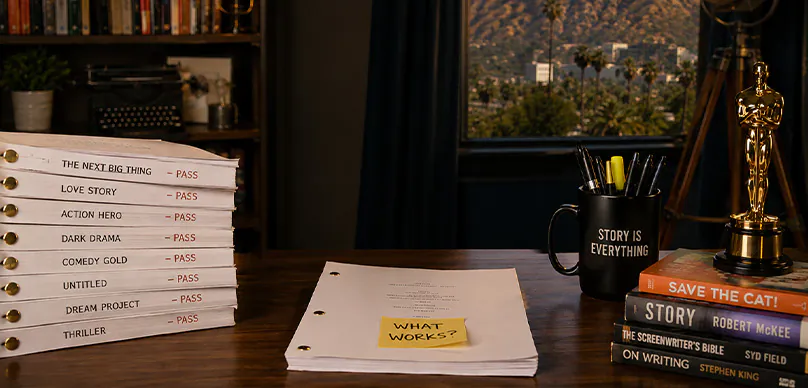
One of the biggest misconceptions about writing is that great stories sell themselves. Most writers assume that if the script is good enough, eventually someone will recognize its brilliance. The reality is much harsher. Before anyone reads page one, before they evaluate the dialogue, the characters, or the structure, they first need a reason to care. That reason often comes down to a single sentence. In this conversation with Lane Shefter Bishop, a producer and development executive known throughout Hollywood as “The Book Whisperer,” the discussion revolves around one deceptively simple concept: if you can’t clearly explain your story, you probably don’t fully understand it yet.
Lane’s journey through the entertainment industry is anything but conventional. She worked throughout Hollywood in a variety of roles, from studio assistant positions to directing and producing, eventually becoming a specialist in developing books for film and television adaptation. Along the way she discovered something surprising. The projects that moved fastest were rarely the ones with the longest manuscripts or most detailed pitches. They were the projects with the clearest concepts. Whether she was setting up a project with major producers or pitching unpublished material to executives, success often depended on reducing hundreds of pages into a single compelling idea.
What makes Lane’s perspective particularly valuable is that she often acquires material before the books are even completed. Instead of waiting for finished manuscripts, she evaluates proposals, outlines, and partial drafts. That means she frequently makes decisions based almost entirely on the strength of a concept. For filmmakers and screenwriters, this offers an important lesson. Industry professionals are constantly searching for ideas that can be communicated quickly and understood immediately. Complexity is not always an advantage. Clarity is.
The central theme of the conversation revolves around the logline. While many writers treat the logline as a marketing tool created after the screenplay is finished, Lane argues that it should exist before the writing process even begins. She describes the logline as the rudder of the story—the mechanism that keeps the narrative pointed in the right direction. Without it, writers often drift into what she calls “event-to-event storytelling,” where scenes happen one after another without a clear objective driving the narrative forward.
One of the most useful frameworks she shares is that every strong logline contains three essential elements: the protagonist, what the protagonist wants, and what is at stake. While this sounds simple, it immediately exposes weaknesses in many scripts. Writers frequently know who their protagonist is and what they are trying to accomplish, but they neglect the consequences of failure. Without meaningful stakes, audiences have no reason to become emotionally invested. If nothing significant happens when a character fails, the story loses its urgency.
This insight extends beyond pitching and into screenplay development itself. During the conversation, several examples emerge where the process of building a logline reveals structural problems in the script. If a writer cannot identify the central goal, perhaps the protagonist is passive. If the stakes feel weak, perhaps the conflict needs to be intensified. If the protagonist isn’t driving the story, perhaps the wrong character is at the center of the narrative. The logline becomes less of a sales tool and more of a diagnostic tool for storytelling.
Another fascinating point is Lane’s emphasis on specificity. Many writers believe broader concepts create broader appeal, but she argues the opposite. Specific details are often what make stories unique. Generic concepts blend together. Distinctive details create curiosity. Her job involves reading hundreds of projects every year, and she repeatedly returns to the importance of identifying what makes a story different from everything else competing for attention. That difference often becomes the heart of the logline itself.
The conversation also highlights the importance of industry access. Lane strongly encourages writers to attend conferences, workshops, and networking events where they can interact directly with agents, publishers, and executives. While many writers focus exclusively on improving their craft, successful careers often depend equally on learning how to communicate ideas and build relationships. A brilliant screenplay hidden in a drawer has little chance of changing anyone’s life. A strong concept presented to the right person at the right time can open doors unexpectedly.
Perhaps the most memorable advice comes near the end of the discussion. Writers are often told to “write what you know,” but Lane references a quote from bestselling author Anne Perry that offers a more useful perspective: “Write about what you care about.” Knowledge can be researched. Passion cannot. The stories that resonate most deeply usually emerge from subjects that genuinely matter to the writer. When combined with strong structure, meaningful stakes, and a clear concept, that passion becomes the foundation for storytelling that audiences actually remember.
For writers, filmmakers, and storytellers at every stage of their careers, the lesson is clear. Before worrying about agents, producers, budgets, or distribution, first answer a simpler question: can you explain your story in one unforgettable sentence? If you can, you may already be further ahead than most writers trying to break into the business.