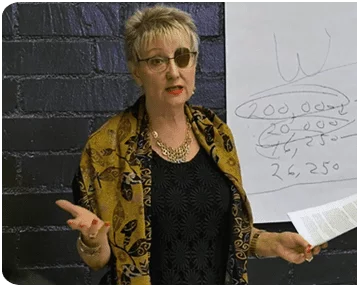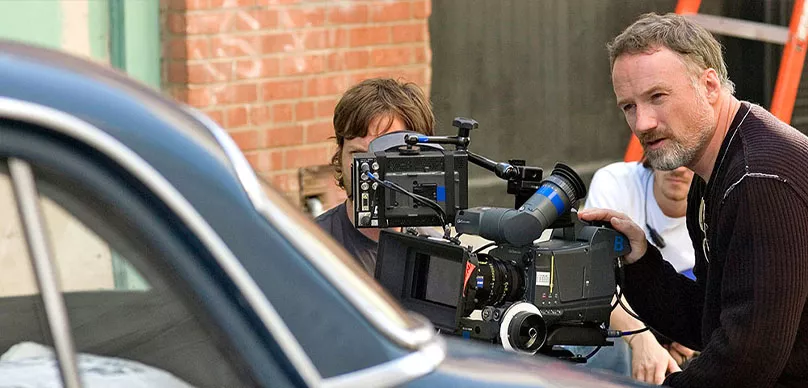
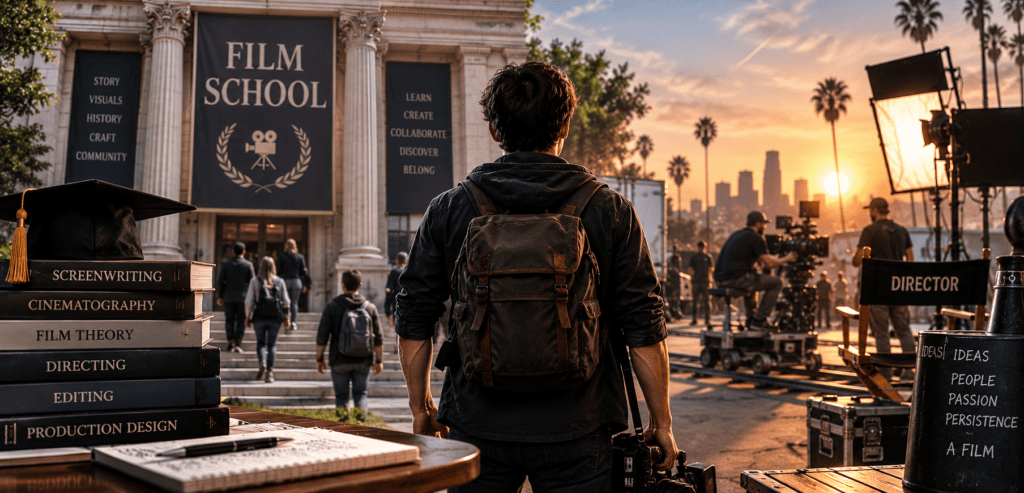
There is a question almost every aspiring filmmaker eventually encounters: Do I actually need film school? It sounds simple until you realize filmmaking careers rarely follow straight lines. Some people spend years studying cinema before entering the industry. Others begin carrying equipment, grabbing coffee, and learning everything through the beautiful chaos of a working set. Miranda Sajdak, a writer, producer, and director who has worked across studio productions, independent films, television, development, and her own creative projects, has experienced enough sides of the business to understand that there isn’t one correct answer.
Miranda knew she wanted to make movies from childhood. Her mother took her to see A League of Their Own, and something about watching women become the center of that story immediately connected with her. She walked out of the theater knowing she wanted filmmaking to become her life. That desire eventually took her to Columbia, where film school provided something beyond textbooks and lectures. It gave her access to other filmmakers, practical experience on graduate student productions, an understanding of set etiquette, and professors who helped narrow the overwhelming universe of cinema into material worth studying.
But Miranda is careful not to turn her experience into a universal prescription. Film school helped her, but that doesn’t mean everybody needs it. Plenty of filmmakers learn cameras, filmmaking history, theory, and set protocol independently. Others simply begin working. What matters is understanding where you want to go and determining which path gives you the skills, relationships, and experience necessary to get there. Miranda’s film-school experience ultimately helped prepare her to work as a PA on productions including The Bourne Ultimatum and Cloverfield.
Those jobs also reinforced another truth about the industry: relationships matter. Miranda recalls that one opportunity likely came through a production-office application while another came through a referral. As she puts it, many jobs in the film industry come down to networking and who you know. But networking isn’t simply collecting contacts at parties. The most valuable networking happens when people know how you work. Someone sees that you’re reliable, professional, and capable under pressure, and when another production needs somebody, your name enters the conversation.
Working on studio movies also gave Miranda an interesting comparison with independent filmmaking. Both environments are ultimately trying to accomplish the same thing—tell a story—but the scale changes everything. A union studio production has larger departments, specialized crews, more resources, and potentially far more time for individual shots. On an indie film, the director or producer might suddenly find themselves solving problems that would normally belong to an entire department. Miranda loves that hands-on quality because it allows filmmakers to understand practically every corner of production.
And sometimes those problems become completely absurd.
Miranda recalls producing a film in upstate New York during winter where the climactic scene required a teenage girl to help a horse give birth. The production was filming on a horse farm with pregnant horses, so everything initially seemed manageable—until they discovered that the horse wasn’t going to give birth during their shooting schedule. Suddenly Miranda had to locate another pregnant horse that looked similar enough, find a farm whose location could match, and somehow coordinate the production around an event that couldn’t be scheduled precisely.
There wasn’t modern mobile internet to rescue her. Miranda picked up a landline, opened the Yellow Pages, and started calling horse farms. Within roughly an hour, she had two possibilities. The production eventually found a horse about to give birth, moved the crew, captured the sequence on film, and got the movie made. It’s a wonderfully ridiculous example of what producing actually means. Nobody hands you a manual explaining what to do when the horse in your climax refuses to cooperate. You solve the problem in front of you.
Miranda’s television experience provided a different education. Working as an assistant on shows including Huge and China, IL taught her not only about writing but about the business surrounding writers. Writers often create alone, but television and filmmaking are collaborative industries. Networks give notes. Studios request changes. Characters disappear. Scenes get rewritten. A writer who treats every sentence as sacred is going to struggle. Miranda emphasizes the importance of humility: “There will be rewrites. There will be a lot of rewrites.”
That philosophy eventually extended into creating her own opportunities. Miranda and producer Sandra Leviton formed Script Chicks after leaving coordinator positions to pursue producing independently. The challenge was painfully familiar to indie filmmakers: passion projects don’t necessarily pay the rent. They needed flexible work that would allow them to continue writing, directing, and producing. Their years of development experience gave them something valuable they could sell—professional screenplay coverage. The business became a way of keeping the lights on while continuing to pursue their filmmaking goals.
That may be one of the most useful lessons in Miranda’s story. A filmmaking career isn’t always built by doing one job continuously until Hollywood finally notices. Sometimes you PA on studio movies. Sometimes you read scripts. Sometimes you assist writers. Sometimes you produce somebody else’s project so you can finance your own. Sometimes you start a business because the business gives you enough freedom to continue creating.
Eventually Miranda realized that although she had spent years writing, producing, and working throughout the industry, she had drifted away from the original dream that brought her there: directing. So she wrote another short, gathered trusted readers who weren’t afraid to criticize the screenplay, started assembling a cast, and began crowdfunding an action project. Rather than waiting for the perfect circumstances, she started moving toward the work she actually wanted to make.
The path into filmmaking may begin at film school, on a PA job, inside a writers’ room, or with a camera in your bedroom. Miranda’s journey suggests that the specific doorway matters less than what you do after walking through it. Learn how sets work. Build genuine relationships. Listen to notes. Lose the ego. Become resourceful. Find ways to financially survive while you’re developing your craft. And when you realize you’ve wandered away from the reason you wanted to make movies in the first place, find your way back to it.