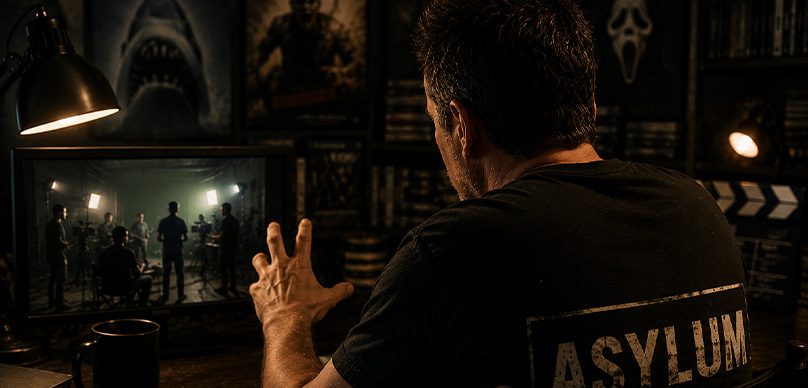
Most independent filmmakers spend years trying to get one movie made. David M. Latt helped build a company designed to make movies continuously. As co-founder of The Asylum, the independent studio behind Sharknado, Mega Shark vs. Giant Octopus, Z Nation, and hundreds of other productions, David represents a very different side of filmmaking—one where creativity, production, distribution, marketing, and financial survival all have to operate together. His story is less about waiting for Hollywood to approve a project and more about constructing a system that allows filmmakers to keep working.
The Asylum didn’t begin with a sophisticated business plan. David and his partners had lost their jobs around the same time and simply knew they wanted to continue making movies. For years they worked out of an apartment, taking whatever opportunities came their way. The company initially released art-house films before creating relationships with major video retailers and eventually moving into genre filmmaking. One of the most important turning points came when they realized they couldn’t compete with larger distributors offering filmmakers substantial minimum guarantees. Instead of fighting for finished movies, they decided to make their own. An investor helped finance an initial group of low-budget horror projects, and the business gradually became a cash-flow operation where revenue from existing movies helped finance the next slate.
That production model explains one of the most interesting philosophies David shares: The Asylum doesn’t necessarily think of itself as making “small movies.” It thinks of itself as making large concepts under strict financial limitations. Rather than designing scripts around four characters trapped in a room because that’s cheap, the company embraces monsters, disasters, submarines, oceans, visual effects, massive action, and whatever else the story requires. “We’re not making a low budget film. We’re just making a big budget film on a budget,” he explains. The limitations are real, but instead of automatically shrinking the concept, the production team searches for creative ways to achieve it.
The other half of the equation is financial discipline. Because The Asylum operates as both producer and distributor, the company frequently knows what a movie is worth before production begins. If a film has already been pre-sold for a certain amount, David’s job as producer is brutally straightforward: make the movie for less than the guaranteed revenue while accounting for company overhead. That sounds obvious, yet it runs against a filmmaking culture where budgets frequently expand based on creative ambition rather than realistic revenue. The Asylum survives because the production budget follows the economics of the marketplace. As David puts it, they haven’t lost money because he simply refuses to spend more than they have.
That buyer-driven approach also changes how projects are developed. The Asylum usually doesn’t sit around brainstorming random movie concepts or waiting for writers to submit scripts. Networks, distributors, and buyers tell them what kind of content they need, and The Asylum develops projects specifically for those opportunities. If a network wants a movie involving sharks and a storm, the company manufactures the screenplay internally rather than hoping someone happens to submit exactly that idea. This is why David repeatedly explains that The Asylum rarely accepts unsolicited scripts. The creative process begins with understanding what the buyer needs, then finding filmmakers and writers who can turn that requirement into something entertaining.
No example demonstrates the unpredictability of filmmaking better than Sharknado. By the time the movie arrived, The Asylum had already produced around 150 films. Nobody inside the company believed this particular project would become a cultural phenomenon. David admits he initially didn’t fully understand the screenplay and worried that its comedic tone was too far outside the company’s usual approach. Casting was difficult because actors didn’t want their names associated with something called Sharknado. The production even used another working title while trying to secure talent. Yet Sci-Fi strongly believed in the concept, David trusted the buyer, and the movie went forward. What looked like another routine production became the project that transformed public awareness of The Asylum.
That unpredictability is also why the company keeps producing. David’s philosophy isn’t built around finding one perfect film that changes everything. It’s about repeatedly stepping to the plate. After approximately 150 movies, one happened to become Sharknado. The lesson isn’t that filmmakers should deliberately manufacture ridiculous viral concepts; it’s that nobody truly knows what audiences will embrace. The more sustainable strategy is to control costs, understand the marketplace, keep creating, and give yourself multiple opportunities for a project to connect.
The conversation becomes even more relevant when David discusses The Asylum’s expansion into television. As DVD, Blu-ray, and traditional VOD economics weakened, the company recognized that audience behavior was moving toward episodic content and binge viewing. Rather than stubbornly protecting the old model, The Asylum adapted, eventually producing Z Nation for Sci-Fi. That transition required operating at a larger scale, but it reflected the same philosophy that built the company in the first place: follow where the audience and the buyers are going, remain flexible, and don’t become emotionally attached to a distribution model simply because it worked yesterday.
Perhaps the most practical advice David offers has nothing to do with sharks, budgets, or visual effects. It’s about relationships. The film industry, he argues, is built through people. Go to festivals. Attend seminars. Go to parties. Shake hands. Meet filmmakers, producers, executives, writers, and crew members. Sending resumes only goes so far. Opportunities often emerge because someone remembers that you were reliable, enthusiastic, professional, and ready when the right project appeared. The Asylum itself grew through relationships, changing markets, unexpected deals, and the willingness to say yes when an opportunity made sense.
In the end, David M. Latt offers independent filmmakers something far more useful than a formula for creating another Sharknado. He provides a case study in sustainability. Know what your movie is worth. Control the budget. Build infrastructure. Understand your buyers. Adapt when markets change. Surround yourself with people who know how to execute. And above all, keep making movies. Because in independent filmmaking, the project that changes everything is often impossible to predict until after you’ve made it.