Some documentaries begin with years of research, development meetings, financing plans, and carefully structured production schedules. Others begin because someone gets locked out of work.
That’s exactly what happened to Mark Phillips, whose documentary The Walking Fool emerged from one of the simplest creative sparks imaginable. Working as a graphic designer in New York, Mark found himself standing outside an office one cold morning while waiting for a perpetually late boss to arrive. Instead of sitting around, he decided to take a walk. During that walk, he noticed details he had driven past for years without ever seeing. A plaque. A historic home. A forgotten piece of American history. That small discovery triggered a much larger question: what else do we miss when we move through life too quickly?
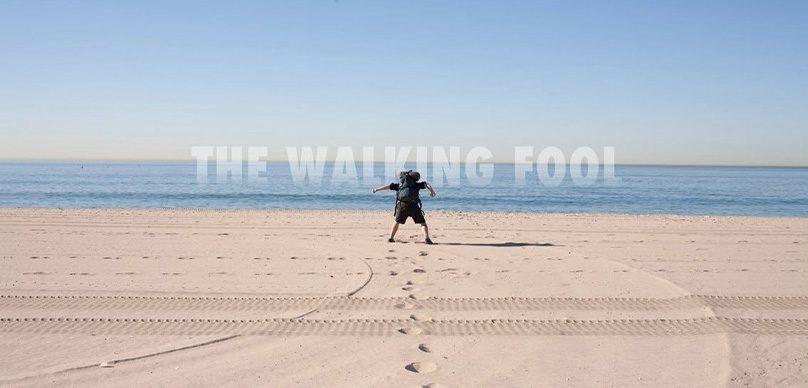
That curiosity eventually evolved into an audacious idea: walk across America. Not drive. Not cycle. Walk. One step at a time from the Atlantic Ocean to the Pacific Ocean. At the time, Mark wasn’t even thinking about making a documentary. He viewed the journey more like an extended public-access television project, a giant adventure that would allow him to capture interesting moments and share them with a small audience. The goal wasn’t fame, distribution, or film festivals. It was simply the excitement of doing something unusual and documenting it along the way.
Like many first-time filmmakers, Mark approached the project with enthusiasm that far exceeded his preparation. His original attempt began in 2001 with limited planning, minimal resources, and an almost reckless willingness to figure things out as he went. Maps were printed, routes were considered, and supplies were packed, but within days he was already improvising. The reality of carrying equipment, managing weight, finding places to sleep, and navigating thousands of miles of unfamiliar territory quickly revealed how different execution is from imagination.
What makes the story particularly compelling is that the first attempt failed.
After making it all the way to South Dakota, roughly halfway across the country, Mark made the difficult decision to quit. The reasons were complicated. Money concerns. Loneliness. Fatigue. Boredom. The psychological burden of constantly documenting the experience while simultaneously trying to live it. He realized that walking across America and making entertainment out of the experience were often competing objectives. The more he focused on filming, the less connected he felt to the actual journey. Eventually, he boarded a bus home and accepted what felt like a devastating personal defeat.
For many filmmakers, that would have been the end of the story.
Instead, it became the beginning.
Over the next decade, the unfinished journey remained in the back of his mind. The experience haunted him. He found himself replaying the decision, questioning whether he had truly given everything he had. What started as regret slowly transformed into motivation. Eventually, after years of working, saving money, and rebuilding confidence, he decided to attempt the journey again. This time, the mission wasn’t about proving anything to other people. It was about finishing something he needed to finish for himself.
One of the most valuable filmmaking lessons in the conversation involves audience building. Mark openly acknowledges that if modern social media platforms had existed during his first attempt, the project might have evolved very differently. He stresses the importance of communicating with audiences throughout production rather than waiting until the film is complete. By sharing updates, involving supporters, and building a community around the subject matter itself, filmmakers can create an audience long before release. In today’s independent filmmaking landscape, that relationship with viewers can be just as important as the finished film.
The conversation also provides a fascinating look at documentary storytelling. Unlike narrative films, documentaries often discover their structure in the editing room. Mark discusses the challenge of transforming years of footage into a coherent narrative while preserving the emotional truth of the experience. Every creative decision becomes a balancing act between entertainment and authenticity. Some of the most powerful moments were never perfectly captured on camera. Others existed only as audio recordings or memories. The challenge wasn’t simply documenting reality—it was finding the story hidden within it.
Perhaps the most inspiring aspect of Mark’s journey is its reminder that failure doesn’t always mean the story is over. In filmmaking, projects collapse. Funding disappears. Scripts stall. Productions fail. But sometimes unfinished work has a way of calling creators back. What matters isn’t avoiding failure. What matters is deciding whether the story is important enough to continue despite it.
For Mark, the answer was yes.
One step at a time.
One mile at a time.
One unfinished dream finally completed.