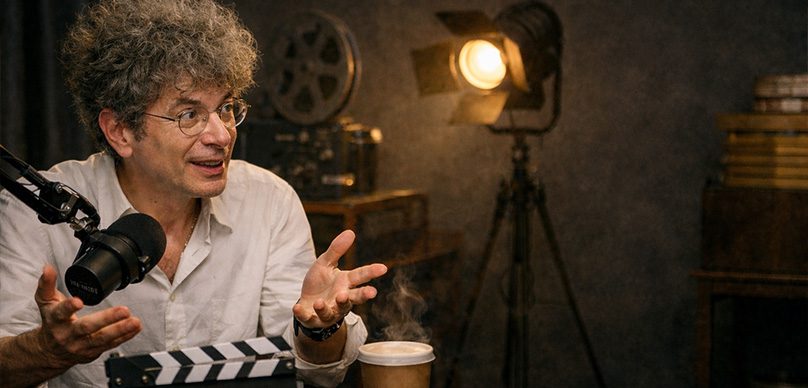
On today’s episode, we welcome James Altucher, an entrepreneur, author, and creative thinker whose approach to idea generation and execution offers a surprisingly practical blueprint for filmmakers and screenwriters. While he’s not traditionally from the film industry, his insights cut directly into one of the biggest challenges creators face—how to consistently come up with ideas and actually turn them into something real.
One of the most striking takeaways from this conversation is the idea that creativity isn’t something you wait for—it’s something you train. Too many writers sit in front of a blank page hoping inspiration will strike, only to get stuck in overthinking, outlining, or self-doubt. James flips that completely. He argues that ideas are a muscle, and like any muscle, they weaken if you don’t use them. His solution is simple but powerful: come up with ten ideas a day, every day.
These ideas don’t have to be good. In fact, most of them won’t be.
That’s the point.
By forcing yourself to generate ideas consistently, you remove the pressure of perfection and replace it with momentum. Over time, patterns start to emerge. Your brain begins to connect concepts faster. And eventually, something clicks—a concept worth developing into a screenplay, a short film, or even a series. As James explains, the goal isn’t to get ten great ideas—it’s to build the ability to recognize one when it appears.
This approach directly applies to screenwriting. Many writers get stuck trying to outline the “perfect” story before writing a single page. But as discussed in the conversation, over-outlining can become a form of procrastination. It feels productive, but it delays the real work. The better approach is to start writing, let the story evolve, and refine it through drafts. The act of writing itself generates clarity.
There’s also a strong emphasis on execution over theory. It’s easy to read books, watch tutorials, and study structure, but none of that replaces actually making something. Whether it’s writing a script, shooting a short film, or creating a web series, the process of doing reveals far more than preparation ever could. James shares examples of creators who started with minimal resources—using basic cameras, simple setups, and limited budgets—and still managed to build something meaningful.
That idea connects closely with filmmaking. The barrier to entry has never been lower. With modern technology, anyone can shoot, edit, and distribute content. Yet many creators still hesitate, waiting for better equipment, more funding, or the “right moment.” In reality, those are just delays. The filmmakers who move forward are the ones who start with what they have and improve as they go.
Another key concept discussed is persistence. In the film industry, rejection is constant. Projects don’t get picked up. Scripts don’t sell. Shows don’t move forward. James shares his own experience pitching ideas, including projects that never made it to air despite initial interest. But instead of viewing those moments as failures, he treats them as redirections—opportunities to pivot and create something new.
“Persistence plus love equals accomplishment,” he explains.
That mindset is critical for screenwriters. A single script rarely defines a career. It’s the body of work that matters—the willingness to keep writing, keep improving, and keep putting ideas into the world. Each project becomes a stepping stone to the next.
There’s also an important discussion about feedback and growth. Improving as a writer requires interaction—with mentors, peers, and even audiences. James describes a system of learning that includes mentors (people ahead of you), peers (people at your level), and students (people you teach). This creates a feedback loop that accelerates improvement. For filmmakers, this could mean collaborating with other writers, sharing scripts, or even teaching what you’ve learned to others.
Ultimately, the conversation comes back to a simple but often overlooked truth: ideas are everywhere, but execution is rare.
You don’t need permission to start.
You don’t need perfect conditions.
You don’t need certainty.
You need to write. You need to create. You need to finish.
In the end, James Altucher offers a framework that strips away excuses and replaces them with action. For filmmakers and screenwriters, that shift—from thinking to doing—is where everything begins.