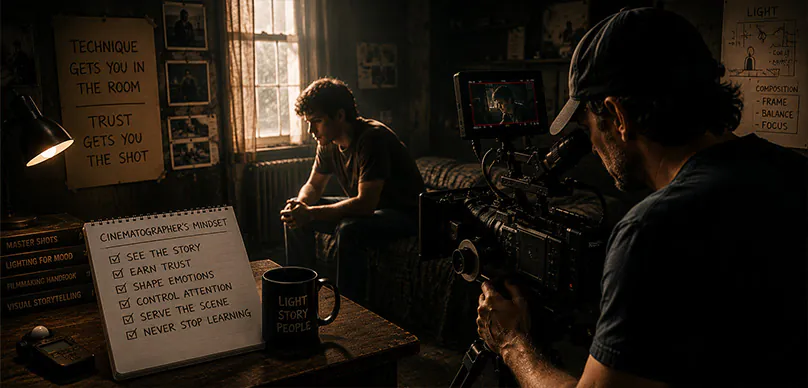
There’s a strange misconception in filmmaking that success comes from mastering equipment. Cameras. Lenses. Lighting setups. Technical jargon. But after listening to Jared Hess, it becomes painfully obvious that the most valuable skill on a film set has almost nothing to do with cameras at all. It’s trust. The ability to walk into chaos, uncertainty, impossible schedules, nervous talent, dangerous environments, and somehow create calm while still delivering beautiful images. That’s the real craft.
Jared’s career path reflects the evolution of modern independent filmmaking itself. Raised around storytelling through his father’s screenwriting background, he entered filmmaking during the DSLR revolution, when cameras like the Nikon D90 suddenly allowed creators to bypass expensive film stock and traditional gatekeepers. Instead of waiting for permission, Jared began creating content guerrilla-style, teaching himself how to solve production problems in real time. That relentless experimentation eventually led him into professional work with ESPN, WWE, Bellator, and major fight productions.
What makes the conversation fascinating is how unglamorous professional cinematography actually sounds. Jared describes shooting in rough Miami neighborhoods where safety became part of the production plan. He talks about entering gyms with barely functioning electricity, unstable environments, and unpredictable personalities. Yet these difficult locations became his training ground. Instead of resisting chaos, he learned to adapt to it. And in many ways, that adaptability became his greatest professional advantage.
One of the strongest themes throughout the episode is the psychology behind filmmaking. Jared repeatedly emphasizes that talent management matters as much as lighting setups. Fighters cutting weight before a match don’t want to spend hours waiting for camera adjustments. Celebrities constantly surrounded by cameras don’t automatically trust another filmmaker walking into the room. Jared explains that the cinematographer’s energy directly affects the subject’s comfort level. If the crew appears nervous, stressed, or disorganized, the subject immediately shuts down emotionally.
That idea expands into a larger lesson about leadership on set. Too many filmmakers believe authority comes through aggression. Jared sees it differently. Calmness creates trust. Preparation creates confidence. Communication creates momentum. Even when productions go wrong—and they always do—the crew takes emotional cues from leadership. “You want them to feel relaxed,” he explains, describing how important it is to humanize yourself before interviews or emotionally vulnerable moments.
The conversation also offers incredibly practical advice for directors working with cinematographers. Jared stresses the importance of trust between directors and DPs. Once a cinematographer is hired for their visual ability, constant micromanagement only slows the process down. He argues that strong pre-production communication solves most on-set problems before they even happen. When the creative vision is aligned beforehand, the production day becomes about execution instead of confusion.
Another fascinating part of the interview revolves around modern digital cinematography itself. Jared discusses the challenges of judging images across different monitors, lighting environments, and workflows. He specifically praises OLED monitors as one of the most important technological tools for modern cinematographers because they provide more reliable image accuracy in unpredictable shooting conditions. While this may sound technical, it reveals something deeper: modern filmmakers are constantly balancing artistic instinct with rapidly evolving technology.
But beneath all the filmmaking advice lies something much more universal. Jared’s philosophy ultimately comes down to humility. He repeatedly returns to the importance of relationships, professionalism, and making others feel comfortable. Great productions are rarely built through ego. They’re built through trust, collaboration, patience, and consistency over time. The cinematographer is not simply capturing light. They are managing emotional environments while shaping visual storytelling under pressure.
And maybe that’s why the best filmmakers often appear calmer than everyone else on set.
Not because things aren’t falling apart.
But because they’ve learned that panic never improves the image.