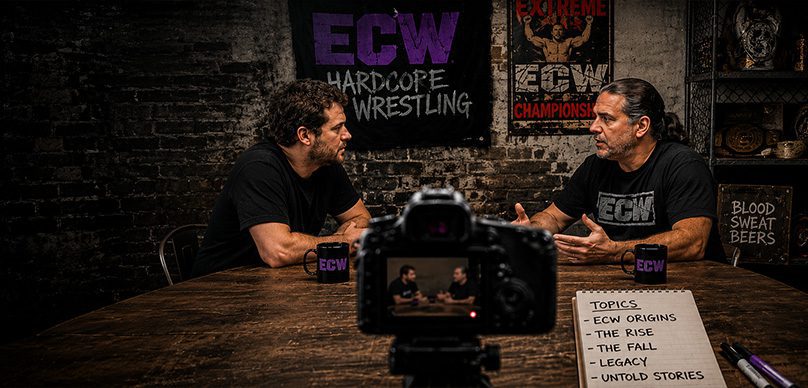
Some documentaries are made to entertain. Others are made because the filmmaker becomes obsessed with understanding a world that most people either misunderstand or completely ignore. That’s what makes this conversation with John Philapavage so compelling. What began as a teenager’s fascination with ECW wrestling culture slowly transformed into a 13-year filmmaking odyssey that became Barbed Wire City, an ambitious documentary about the rise, chaos, mythology, and emotional aftermath of Extreme Championship Wrestling.
John’s journey into filmmaking didn’t begin in film school or Hollywood. It began with childhood creativity, VHS cameras, comic books, and DIY storytelling experiments with his lifelong creative partner Kevin Kernan. Growing up in Pennsylvania, surrounded by wrestling culture and underground fandom, they became fascinated not just by wrestling itself, but by the people orbiting around it—the fans, performers, promoters, and strange emotional ecosystem that ECW created. That curiosity eventually evolved into something bigger than fandom. It became anthropology through filmmaking.
One of the most fascinating aspects of the conversation is how John reframes the purpose of the documentary itself. While many wrestling fans expected Barbed Wire City to simply celebrate ECW nostalgia, John approached the project differently. He wasn’t interested in creating propaganda or fan service. He wanted to document truth—even when that truth became uncomfortable. That meant examining violence, manipulation, obsession, cult-like fan loyalty, and the emotional cost that ECW left behind for many of the people involved.
That approach created enormous challenges during production. Interview subjects often contradicted each other. Some intentionally distorted facts. Others blended reality with wrestling mythology until even they no longer seemed fully certain what was true anymore. John explains how difficult it became to untangle truth from performance in a business built on illusion. “There’s your version, my version, and the truth,” becomes one of the underlying themes of the entire episode.
The interview also becomes an incredible lesson in documentary filmmaking psychology. John talks openly about learning how to interview subjects without appearing threatening, judgmental, or overly fan-driven. Early on, wrestlers viewed him as “just a fan,” which often limited access and credibility. But over time, he learned how to position himself more like a filmmaker and investigator rather than a superfan seeking validation. That subtle shift changed everything. Referrals began happening. More wrestlers agreed to interviews. Trust slowly built over years of persistence.
And then there are the unbelievable production stories.
At one point, John describes interviewing New Jack while the wrestler casually held a machete across his lap during the interview. The tension wasn’t performative—it felt genuinely dangerous. Yet John also reveals something deeper about documentary work: often the filmmaker’s job is to stay calm long enough for the truth to reveal itself naturally. Some of the documentary’s most memorable moments emerged not from controlled interviews, but from simply allowing unpredictable personalities to exist honestly on camera.
The crowdfunding section of the conversation is equally valuable for independent filmmakers. John offers brutally honest lessons about Kickstarter, budgeting, rewards fulfillment, and the hidden costs creators rarely anticipate. He explains how many crowdfunding campaigns fail not because the project lacks passion, but because creators underestimate logistics. Shipping costs, rewards, travel, licensing, and production expenses can quietly consume an entire campaign budget if not carefully planned.
Perhaps the most powerful takeaway from the episode is the sheer persistence required to finish independent films. Barbed Wire City was not made with studio financing, giant crews, or guaranteed distribution. It survived because two filmmakers refused to let the project die. Over thirteen years, the documentary repeatedly stalled, restarted, evolved, and nearly disappeared entirely. Yet John continued gathering footage, building relationships, researching wrestling history, and refining the story until the film finally became real.
And in many ways, that persistence becomes the true story behind the documentary.
Not wrestling.
Not ECW.
Not nostalgia.
But the simple reality that independent filmmaking often becomes an endurance test between the creator and time itself.