There is a strange irony in the world of screenwriting. We spend years searching for the perfect formula, the ideal three-act structure, the precise moment when a character must change, and the magical sequence of events that will transform an ordinary screenplay into something unforgettable. Yet some of the greatest films ever made came from writers who understood that structure was never the destination. It was simply the machinery that allowed the story to come alive. In this fascinating conversation, we welcome Matt R. Lohr, an award-winning screenwriter, essayist, film critic, and co-author of The Dan O’Bannon Guide to Screenplay Structure, who shares what he learned working alongside one of Hollywood’s most imaginative storytellers.
Matt’s journey into Dan O’Bannon’s world began while he was pursuing his MFA in screenwriting at Chapman University. O’Bannon, the legendary writer associated with Alien, Total Recall, and The Return of the Living Dead, had arrived as the school’s filmmaker in residence. At the time, Matt was working on his thesis screenplay under Leonard Schrader, the Academy Award-nominated screenwriter of Kiss of the Spider Woman. When Schrader announced that O’Bannon needed help developing a screenwriting book, Matt’s classmates immediately recognized the opportunity. Before long, he was renting cars to travel from Orange County to O’Bannon’s home in Pacific Palisades, beginning a collaboration that would fundamentally change his understanding of storytelling.
Their first meeting was hardly what you would expect from a traditional masterclass. After a few minutes of conversation, O’Bannon asked Matt whether he had ever taken psychedelic drugs. When Matt admitted he hadn’t, O’Bannon responded that he looked like Clark Kent. It was an appropriately unconventional introduction to a filmmaker whose career had been built on unconventional ideas. Over the next two years, Matt worked closely with O’Bannon, studying movies, examining screenplay structure, and helping develop a book that would eventually become one of the writer’s final creative legacies. After O’Bannon’s death in 2009, his wife Diane approached Matt about completing the manuscript. Matt spent another year polishing and organizing the material, determined to preserve the voice of the man who had taught him so much.
What makes this experience extraordinary is that Matt wasn’t simply learning screenwriting theory from someone who had studied successful movies. He was working directly with a writer who had created them. O’Bannon didn’t need to speculate about whether his ideas could produce compelling cinema. He had already helped create films that terrified, surprised, and entertained audiences around the world. His understanding of story structure came from years of wrestling with his own screenplays, discovering what worked, recognizing what failed, and developing a system that could help writers construct stories with a strong dramatic foundation.
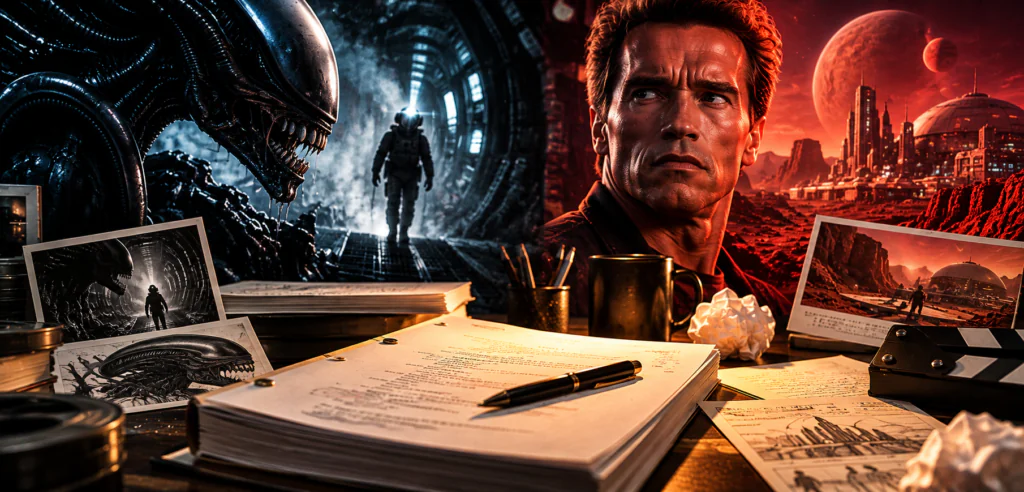
One of the most revealing moments in our conversation involves Alien, a film that continues to demonstrate how brilliantly structure and genre can work together. Matt explains that the first half of Alien operates almost entirely as science fiction. The characters are curious about the unknown. They discover a mysterious signal, explore an unfamiliar environment, and attempt to understand what they have encountered. Then comes the unforgettable chestburster sequence, and the entire emotional experience of the movie changes. Suddenly, curiosity becomes terror. The characters no longer care where the creature came from or what it means. They simply want to survive. The movie has transformed from a story about investigating the unknown into a story about fearing it.
That transformation is more than a clever genre trick. It reveals something essential about storytelling: a screenplay must constantly evolve the audience’s relationship with its characters and conflicts. The most effective stories don’t merely repeat the same dramatic situation with greater intensity. They change the nature of the situation itself. Alien succeeds because its shift feels inevitable rather than arbitrary. The characters are established as believable people before the horror fully takes over. Their relationships matter. Their behavior feels natural. By the time the creature begins hunting them, the audience has already developed an emotional connection to their survival.
Matt contrasts this with Prometheus, which he feels struggles in part because its characters lack the same natural camaraderie. In Alien, the crew feels like a group of working people who have spent considerable time together. Their conversations, disagreements, and casual interactions create a believable social environment. In Prometheus, the characters often seem unfamiliar with one another, making their relationships harder to invest in. This is a valuable lesson for every screenwriter: spectacle can attract an audience, but character relationships are often what keep that audience emotionally involved.
Another unforgettable story comes from Matt’s experience watching The Return of the Living Dead privately with O’Bannon. What began as a routine visit to work on the book became an impromptu screening while O’Bannon reviewed the film’s color correction for a home-video release. As they watched, the director began sharing stories about the special effects, production problems, locations, and creative decisions behind the movie. Matt found himself receiving something few aspiring filmmakers could ever experience: a personal director’s commentary from the person who had made the film. The lessons weren’t delivered through a lecture. They emerged naturally from conversation, observation, and the shared love of movies.
That experience also reinforced how important it is for filmmakers to study the work of other filmmakers. Watching movies for entertainment is wonderful, but watching them with an analytical eye can transform the way you write. Why does a scene work? Why does a character feel believable? Why does a moment of tension land? Why does one film survive a dramatic tonal shift while another falls apart? These questions are essential because the answers often reveal the invisible structure holding the movie together.
Matt also offers one of the most immediately practical screenwriting lessons in the entire conversation: read your dialogue aloud. As he explains, “You’re not writing words that have to live on a page. You’re writing lines that actors have to be able to say.” That simple distinction can transform the rewriting process. Dialogue may look beautiful in Final Draft and still sound completely unnatural when spoken. Characters shouldn’t deliver lines simply because they communicate information efficiently. Their words need rhythm, personality, intention, and the unpredictable quality of real human speech. Matt believes strong dialogue comes partly from being an attentive listener, absorbing how people actually communicate, and developing an instinct for language.
Interestingly, O’Bannon’s book doesn’t attempt to teach every element of screenwriting. He believed some skills, particularly dialogue, depended heavily on a writer’s individual abilities. His focus was helping writers construct a screenplay with a structure that could support the story from beginning to end. The book explores the thinking of Aristotle, Lajos Egri, Syd Field, Robert McKee, and other influential storytelling theorists before presenting O’Bannon’s own approach. The point isn’t that every screenplay must obey one rigid formula. It’s that understanding the mechanics of storytelling gives writers the ability to diagnose problems instead of endlessly rewriting without knowing what’s broken.
We also explore a difficult reality facing screenwriters: Hollywood’s preference for familiar intellectual property. Matt discusses the industry’s obsession with what executives call presale value, meaning a project’s perceived commercial advantage because audiences already recognize the property. This helps explain why studios repeatedly return to remakes, comic books, video games, toys, and established franchises. For a writer developing something completely original, the challenge can be frustrating. A brilliant screenplay may struggle to attract attention while a recognizable brand receives serious consideration before anyone has solved the storytelling problems. Yet the conversation also reminds us that originality remains essential, especially in independent filmmaking, where smaller budgets can create opportunities to take creative risks.
Horror offers a particularly interesting example. Matt points out that horror is one of the few genres where the genre itself can function as the star. Audiences don’t always need a recognizable actor to become interested in a horror film. They may simply love horror enough to give an unfamiliar movie a chance. That built-in audience creates opportunities for independent filmmakers, but it also creates responsibility. Making a horror film isn’t an excuse to rely on cheap shocks or familiar clichés. The best examples use the freedom of the genre to explore something emotionally or psychologically meaningful.
Near the end of our conversation, Matt shares what may be the most important lesson he learned from O’Bannon. Despite writing science fiction, horror, action, and comedy, O’Bannon never primarily thought of himself as a genre writer. He thought of himself as a storyteller. As Matt recalls, O’Bannon would say, “I’m a storyteller. A lot of my stories just happen to involve monsters and things from outer space.” That philosophy cuts through so much of the noise surrounding modern screenwriting. Before you worry about which genre is selling, which streaming platform is buying, or which formula is fashionable, you have to care about the story you’re telling.
For independent filmmakers, that lesson is particularly powerful. You might be shooting a $10,000 creature feature in a basement on weekends, writing a contained thriller for a handful of actors, or developing a science-fiction film with almost no visual-effects budget. The scale of the project doesn’t determine the seriousness with which you should approach it. Your responsibility is to make the best possible version of that story with the resources available. Respect the audience. Respect the characters. Respect the craft. Never assume that working in a popular genre gives you permission to deliver something careless.
And perhaps that is the real secret behind the enduring appeal of Dan O’Bannon’s work. His movies weren’t memorable simply because they featured aliens, monsters, zombies, or spectacular effects. They worked because beneath those extraordinary surfaces were stories built to capture and sustain an audience’s attention. Structure provided the foundation. Character created emotional investment. Imagination gave the films their identity. And a genuine love of storytelling connected everything together.
So the next time you’re struggling with a screenplay, don’t immediately search for another formula to rescue you. Return to the story. Ask what your characters want, what stands in their way, why the audience should care, and how the dramatic situation evolves. Read your dialogue aloud. Study films that have survived the test of time. Learn from filmmakers who have actually faced the challenges you’re facing. And whatever you’re writing, give it everything you have. Because the goal isn’t simply to write a horror movie, a science-fiction movie, or a commercially marketable screenplay. The goal is to tell a story worth experiencing.